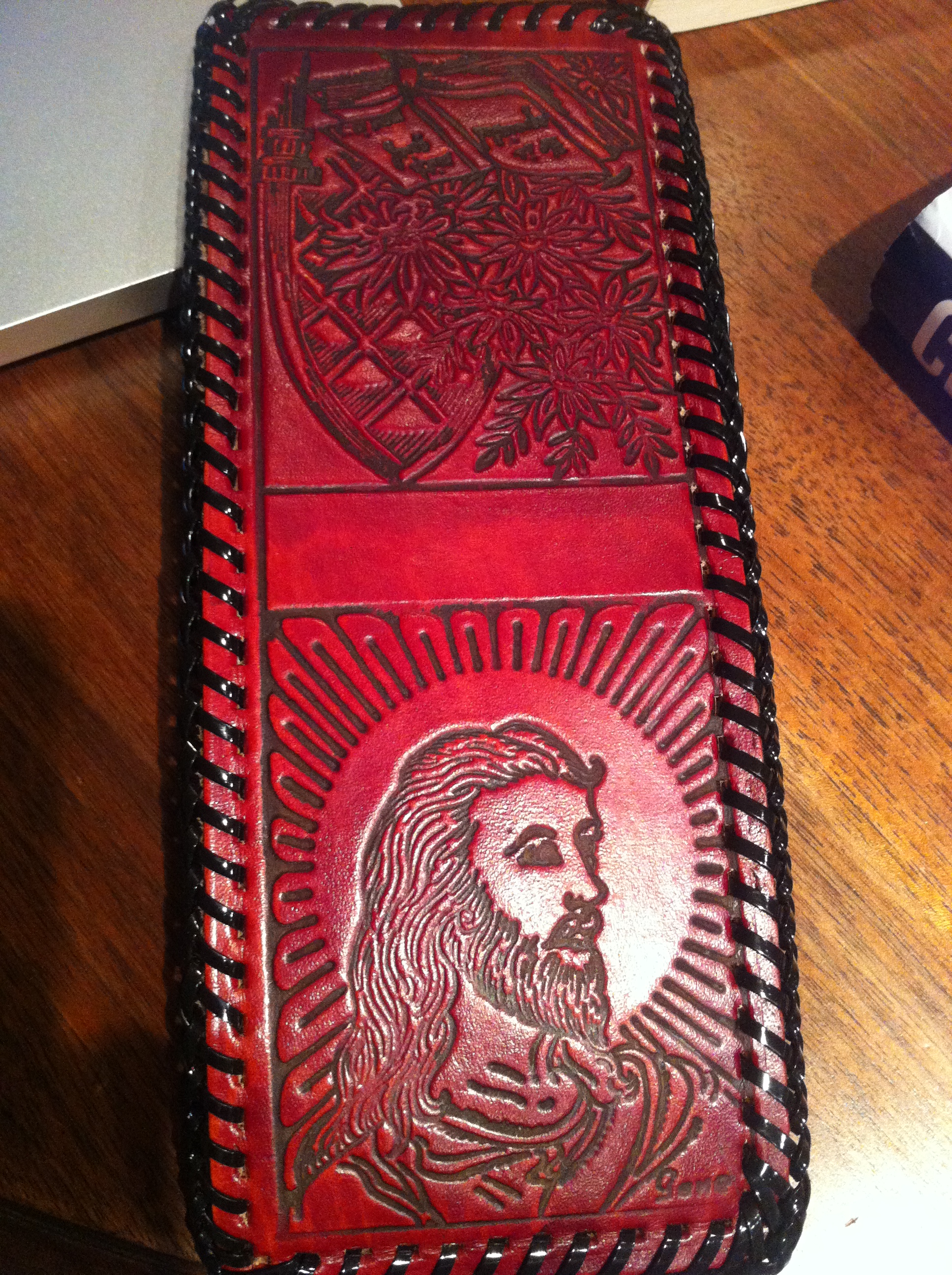
Jesus

The Jesus Wallet

Jesus wallet

When I got home from the airport Thursday evening, waiting for me in the pile of mail, mostly flyers, that had accumulated while I was gone was a small parcel. The parcel was from Virginia. When I picked it up and turned it over, I saw the return address of my friend and fellow Lutheran pastor, Lyndon Sayers. The parcel had a little customs stamp on it saying what was inside. But I didn’t look at that. Instead, I did what any kid with a present would do! I ripped open the envelope and reached inside. And what I pulled out was this:

A wallet.

Now. There are lots of things I can imagine getting from Lyndon and his family. But not that.

Why would Lyndon send me a wallet, I wondered? It was red leather, one of those kinds of wallets I remember from growing up out west. A cowboy-wallet, with stiff, thick leather outers, an soft brown inner liner that smelled of fresh cowhide, and plastic threading winding around the outside. A BIG wallet. The kind you can imagine going with a cowboy hat and 100 dollar US bills. Nice, but not exactly my style.

I turned the wallet around so I could really see it, and that’s when I got the second surprise of the day.

There was the face of Jesus, carved into the leather by one of those leather-working tools and signed “Gene”. On the other side were some intricate flower patterns, and in the middle of them these words, taken from Isaiah 53: “For he was acquainted with grief”.

A Jesus wallet. A real Jesus wallet! Just for me.

When the religious leaders at the Temple in Jerusalem tried to trap Jesus, they did it by asking if it was right to pay taxes to Caesar. They thought they had him with that, since whatever Jesus said, he would have been either against the Emperor or against his own faith. But he answered like this: Why are you putting me to the test? Show me the coin used for the tax. And they brought him a denarius. Then he said to them: Whose head is this, and whose title? And they answered: the emperor’s.

I LOVE my new wallet. Lyndon knows I’m from the west, since he grew up in exactly the same small prairie town I did. And he knows I like kitsch. But as soon as you put Jesus’ face on a wallet, it seems to me that you’re entering some unusual – and potentially challenging -territory.

Imagine pulling that wallet out at the bar when you’re buying a beer. And there’s the face of Jesus, right there, looking you in the eyes. Now in the Gospel of Matthew, Jesus says that one of the things people criticise him for is being a “wine drinker and a glutton”. So maybe a beer wouldn’t be so bad. But imagine pulling out the wallet when it comes time to buy that fancy new cell phone that I KNOW I don’t really need. Or a meal downtown when I could have made a lunch. Or a four-dollar tea at Starbucks when I have a teapot in my office and Canadian Lutheran World Relief is asking for donations to help the refugees in Syria. I wonder if the Jesus wallet might just make me think twice then.

Jesus slid right out of the trap that the religious leaders were setting for him. He did it by saying that whoever’s face is on the coin is who that coin belongs to. Period. Give therefore to the Emperor those things that are the Emperor’s and to God those things that are God’s. In the ancient world, just as in ours, coins are – technically, at least – owned by the state. We just borrow what is known as legal tender.

But then what did Jesus actually mean about giving to God the things that are God’s? He could have been talking about what is holy enough for the Temple offering. Coins with a human image were considered idolatrous by the ancient Jews, who had to change them for special Temple coins that had no such image. But I think there’s a deeper meaning.

Jesus and his interrogators might have been opponents of each other, but as Jews they all believed one thing: when Israel’s God made human beings, it was in the divine image. Every human being bears the stamp of the Creator. As sure as any coin. Two thousand years later we who are Christians have inherited that belief from the Jews. We still say, at least, that we are made in God’s image. We can argue over exactly what that means – is that divine image in our capacity to imagine, to create, to love, or in something else? But somehow, in some important ways, we are, every single one of us, stamped with the divine.

In fact, a lot of books on spirituality say more or less the same thing. I was reading a Buddhist book this past week that said this:


“Science, in its zeal for objectivity, tells us that we are our bodies, the product of Darwinian evolution, originating in a chance combination of molecular gasses, our growth and decay dictated by genetic DNA codes. Thus death is the end. But there is something in the collective unconscious of the human species that intuitively knows that this “objective” definition does not embrace the totality of who we are…” (Levine, Who Dies? viii)


That book would not use the phrase, but we can: we are made in the image of God.

When faced with a dilemma, Jesus upped the ante. He’s like the businesswoman who is forced to sell her store to her opponents but then goes out and buys the whole franchise. Give the coin to the Emperor, he says. It’s only a coin. But you….YOU belong to God.

The point is: we can argue over all kinds of rules and customs. But it’s who and what we are in relation to, that’s important. When we have a baptism, and we pour the water, we say: “So-and-so, child of God, you have marked with the cross of Christ and sealed by the Holy Spirit forever.” For us that’s yet another of the ways we are first made, and then re-made, in God’s image. And our lives can either be a fractured mirror, broken by the sadnesses and troubles and hurts we all go through, or as we grow in maturity and in thoughtfulness and in peace with our own selves and with others, we can grow more and more into the beings we were intended to be. Our reflections will tell the tale.

It’s not easy, of course. Even Moses, when he wanted to meet God, was told he could only see God “on the way by”. You cannot see my face, God answers. I will put you in a cleft in the rock, and I will cover you with my hand until my glory has passed by, and then I will take away my hand, and you shall see my back, but my face shall not be seen.

Rather than a clear-headed, divinely-ordained clarity about the meaning of life and love, most of us kind of muddle through. We live in a world that looks rather more like God’s backside than anything else. We get flashes of what we think might be the truth. But then we fall back into our routines, where life just passes and our email inboxes are so full we despair of ever answering all those messages and we have too many bills to pay and worries to worry about and occasionally real catastrophes, and most of the time we barely even feel awake.

Luther emphasized what he called the “hiddenness of God”. He called it, in Latin, Deus Absconditus. But the message of Matthew seems to be that while we struggle through the darkness, the clearest thing we can do is to seek that image of God in ourselves, and in serving others. The person sitting beside you right now – that is the image of God – for us Christians, that is what Jesus looks like. The baby brought to the font – he or she is the image of God. The foreigner, the immigrant, the differently-abled, the sick, the hungry, the imprisoned. That is what God looks like, for us.

It does feel just a bit weird, having a Jesus wallet. But it’s not Jesus who had a problem with faith and money being so close together. It’s us. When we realize – really realize – and take to heart the image of God in us and in those around us, then we will see that Jesus doesn’t just show up on wallets. He’s everywhere: calling us to real life, and real service, looking for how we can lift up and honour that holy image wherever we find it.


The Football Party

IMG_2133

Years ago I lived in a high-rise university residence. Usually our residence was very quiet, especially on the seventh floor, where I lived. But occasionally, someone would have a wild party. And that’s what happened this one evening.

I ‘d been working nights, all summer long. So I hadn’t had a good sleep in a long while. Very crabby, very tired, I decided to settle down early.

That’s when the party started. Someone, somewhere on those 12 floors, was having a major bash. And it spilled over. First into the halls, then into the elevators.

I tried putting my pillow over my ears.

Up and down slid the elevator, every floor. The door opening and closing. Young women shrieking and young men yelling in big burly voices to each other. It was like frosh week all in my elevator. The noise was especially irritating since it echoed up and down the shaft. I was already in a very bad mood.

I tried closing all the doors in the apartment. I turned on some classical music.

Nothing. Nothing helped.

Finally I broke. For once and for all, I thought, I am going to stop this.

Grabbed a housecoat. Flipped on the lights. Grouchy and going to do something about it. Fuming. Steaming. Don’t bother calling the cops, I thought, I want to take care of this myself.

Went out to the hallway, to where the elevator was. I could hear the kids partying and yelling and laughing as the elevator went up and down and up and down. Forever up and down.

I leaned hard on the button. Kept my hand pressed down, putting all the frustrations of the day into that grip. Muttering to myself: Come to me. Come to me.

You could hear the noise of the elevator approaching, and with it, the party. With every rising decibal I got angrier. Now I’m going to tell those punks a thing or two, I thought. Angry. Furious.

The car came to a stop with a whine. Finally, finally, I was going to get my say. The door slip open. “What do you think you’re doing!” I started. I looked down. That’s funny. Something wrong. Then looked up. Way up. I was looking into everyone’s chest. My anger started to fizzle.

There I was, in my housecoat, looking at an elevator full to the brim with absolutely huge university football players.

The biggest, beer in hand, looked down, WAY down, at me: “Excuse me. What did you want?”

Conflict.

It takes either courage or stupidity to go into a conflict willingly.

But that’s exactly what our lot in life often is, and the Gospel reminds us that being a follower of Jesus doesn’t mean avoiding conflict at all, but maybe – just maybe – handling it differently. Because it isn’t just late-night parties that need resolving. Usually – I hope – you and I don’t face those situations. Sometimes it’s a matter of justice for those we’re supposed to remember – the outcast, the poor. Often, it’s something closer and more personal, maybe something chronic, and we need to ask ourselves: what ARE we willing to confront?

What about relationships? what about our past? our parents even if they’re gone, our children, even if they’re grown, the things we have done ourselves that have never been dealt with.

If the passage about going and pointing out fault, in Matthew, is about anything, it’s about this: ADDRESSING THE ISSUES AND CARING ENOUGH TO FACE UP, IN LOVE TO CONFLICT.

I wonder how many of us can name a moment when we really cared enough to do that, to confront something in ourselves or others, or in the system. One moment which had the power to change our lives. It takes courage to confront. And perhaps the reason most of our lives are so UNlike that elevator encounter has more to do with our lack of courage than our lack of anger.

If another member of the church sins against you, go and point out the fault… says Jesus.

So as far as conflict goes, these words in Jesus’ mouth do not exactly describe a love-in. It’s hard for us to realize that sometimes the better part of love might be to confront something rather than letting it go. In fact, in this particular Gospel lesson we see a way in which conflict is seen as something which can bring people back together rather than driving them apart.

It’s hard to believe, because conflict hurts, and nothing that hurts, our society tells us, can be good. But there, our society is wrong. Sometimes the truth IS painful, and sometimes confrontation which is painful at the time is the only way toward growth in our lives. Anyone who has had a child knows this. There comes a point, with a young child, where the parent has to bite the bullet and put up with the anger. No, your son or daughter CANNOT always have an ice cream EVERY time you go past the ice cream store. If you do that, you’re lost. A little conflict, sometimes, helps to build rather than destroy, relationships.

And the same is true for how we think of the world. In the attempt to see the truth in everybody’s viewpoint, have we lost the notion of truth itself? In the attempt to be fair, have we forgotten that maybe differences can enrich us rather than scare us? That maybe there are actions, and thoughts which are just wrong? Extremism, like we see in ISIS on the news, is just wrong. Greed, that says it’s okay if all the honeybees die so long as I make my stock dividends, is just wrong. Police who are above the law is just wrong. And it takes passion to address such problems, too, in the name of justice, like the prophets did.

It took a lot of anger and fatigue to confront those people. But it takes just as much passion – and a lot more love – to stay connected to people. To build bridges rather than knock them down. To reach out. To go the extra distance. To confront someone and overcome harm and distance and bad blood and bad feelings. To be reconciled, one of the nicest Christian words of all. “God was in Christ,” says Paul, “reconciling the world to himself”.

Conflict – if it is honest, and approached in love – can lead to growth.

We also need to know WHY we confront. “Where two are three are gathered in my name,” said Jesus, “I am there among them.” That’s the key. Our courage is not based – or should not be – on the idea that we are right and someone else is wrong. In other words, we don’t face each other in self-righteousness, but on the belief that when our Lord sits with us, all of us who are human and frail and fallible can work through anything with each other.

For me that evening in the student high-rise, standing there all confrontational like that, I probably didn’t look all that frightening in my bathrobe. But somehow, the largest and burliest and ugliest of these football players looked at me, then at the beer in his hand, and said: ‘Sorry about that – we didn’t think anyone was in bed already. We’ll take it easy and clear the elevator.”

Wow. Confrontation can lead to surprises – occasionally even nice ones. May you and I have the same strength that comes from passion, strength enough to confront our pasts, our presents, injustices, even ourselves. May God grant us to learn from the courage and spirit and reconciliation of Jesus, who so perfectly embodied passion expressed in love.

The Man, not the Mushrooms

chanterelles 2014

This last week I was passing by a big downtown church that I’ve walked by a dozen times, when I noticed that, unusually, the doors were open. Not only that, there was a big sign on the sidewalk that said: “come in, we’re open”.

Now, I’ve always wanted to see the inside of that church. So why not, right? Inside there were a few people milling around looking at things and some folks in the pews just sitting. I stood there a second and then a young woman approached me: “I’m a volunteer guide,” she said cheerfully. “Do you have any questions?” Great, I thought – this gets better and better. Not only are the doors open, I get my own personal guide. So I asked her about the stained glass.

She never skipped a beat. Immediately she pointed up to the front. Do you see that panel there? I squinted. Yes. That’s a Canadian soldier, she said, with an air of great authority. And do you see that one there? I looked. Yes. That’s Saint George. And that one there? I nodded. That’s St-Iona. Then she gave me the date of the windows too.

I was so excited at having my very own guide that I almost didn’t realize at first what she’d said. Umm…. Wait a minute, I said, finally, almost apologetically, when it hit me. Did you say “Saint Iona“?

Yes, Saint Iona, she repeated. Again, that air of absolute authority. As if she’d been studying Saint Iona for years and had become the world expert on all things Saint Iona-ish.

The problem is: this is something I actually know a bit about. Iona isn’t a person. It’s an island. Last I checked, pieces of land can’t become saints. Except sometimes towns in Quebec!

Isn’t Iona an island? I asked her. I was honestly confused. Maybe I’d heard wrong. Do you mean St Columba, I said to her, you know, the saint who lived ON Iona?

For the first time her face dropped a little and her voice became just a tad less authoritative. Oh…she said….right. Then she looked away. I meant to say St Columba. I must have gotten my words mixed up. Saint Columba….you’re right. Then she looked up again at the window. But that person there? she went on. That’s a Canadian soldier. And that knight is St George. Her certainty started to come back and with it, her tendency to point.

I noticed, at this moment, that the OTHER woman at the desk, an older woman, had been watching our conversation with a worried look. She came scurrying over. “What did she tell you about the window?” the older woman asked. She was looking steadily, and a bit accusingly, at the younger person. “I just said what it was,” said the younger woman. “Well?” asked the older, looking at me. I hardly knew what to do. All I’d wanted to do was to see the church.

Who do people say that the Son of Man is? asked Jesus.

            It seems like a fair enough question. Who do people say the Son of Man is? But it’s a tough question. One theologians are still trying to answer, two thousand years later.

In the Gospel of Matthew, when Jesus first asks this, apparently all the disciples have a go at an answer: Some say John the Baptist, says one. Others are guessing Elijah, says someone else. They think perhaps Jeremiah, shouts out a third. Or maybe one of the prophets, adds somebody from the back.

This group almost sounds like one of my classes at the university. There’s a lot of discussion because of how Jesus has framed the question: “who do people say the Son of Man is?”

So long as it’s general, it’s easy to have opinions. I have an opinion about how best to lose weight. Just don’t ask me if I’m doing it. Or if someone says to me: ‘what are people saying these days about how best to help save the environment?’ I have lots of opinions about that, too. I could show you books. But if that same person were an environmental activist, and were to turn to me and say ‘and what do YOU say? What are YOU doing?’ that’s a different thing entirely.

So long as it’s general, a question is just a topic of conversation. But if you read the Gospels, Jesus is never safe. Jesus does what Jesus ALWAYS does: he makes it personal.

Who do YOU say that I am?

On Friday a friend of mine gave me a bag full of fresh chanterelles mushrooms that he’d picked out in the woods in the Eastern Townships. At first when he gave them to me I was so happy I could hardly wipe the grin off my face. What luck! What a generous thing to do! I’ve had pfifferlingen in Germany and was lucky enough to pick some in Sweden last summer with another friend. I didn’t think I’d get a chance this year. I couldn’t wait to get home and saute this batch up with onions and start eating. As I hurried home I could taste them already.

But then while I was walking I started thinking. My friend in Sweden is a mushroom expert, who has taken courses in how and what to pick. My friend in Verdun, so far as I know, isn’t. A nice guy, and probably knows a lot about them. He and his wife had probably eaten from this batch, I was pretty sure. But the words “pretty sure” kept sticking in my mind. I put the mushrooms in the frying pan, sauted them up, and they looked beautiful. But by the time I’d put them on my plate, that bit of doubt had gotten lodged. What if my friend had made a mistake? The wrong mushrooms….well. You know.

The point is: in the end, doesn’t faith always come down to a person? Do we TRUST ourselves to this person? Opinions are cheap. But when someone asks us what we’re really willing to put on the end of our fork, then we realize, even in that little bit, what faith is.

Who do YOU say that I am? asks Jesus. And the response cannot simply be “I believe this and this and this about you.” That’s information. What trust is, is “I believe YOU.” Enough to eat the mushrooms, which I did, and they were delicious. Or in the case of Jesus, enough to follow, and to try to understand how to live under the cross. Enough to take time over years to learn from your living presence about suffering, and hope, and death, and life, and being real, even in pain, and about solidarity and justice, and peace that passes understanding, and a spirit that wants to shout out sometimes from the pure joy of living.

The question who do you say that I am? isn’t to be answered with some kind of proposition. We don’t say to the person who has just unburdened their heart in front of us and broken into tears: I believe you are a friend. Or I believe that once upon a time you must have been a friend. To someone, somewhere. We say: I am your friend. You are mine. Here I am. Here is my hand.

This week in the big church downtown, it turned out that my tour guide really didn’t know what she was talking about. The older guide had to set me straight about just about everything.

Belief isn’t something abstract and it’s not something automatic. It’s not even a thing, really. It’s about people, and what we’re willing to commit ourselves to and test and forge, and forgive, and learn from and grow into. Sometimes, as with my guide, we make mistakes. Belief is taking a chance, because in a relationship there’s always risk. Even with Jesus. But if we DO risk, if we DO trust, then we begin to build the links that can guide us in life AND in death. And Jesus says that if that happens, even “the gates of Hades will not prevail” against such a faith. Pray God it’s true, and trust God it is.

Did Jesus Flirt?

Baby Jesus Grapes Cranach

There are just some things that we don’t imagine Jesus doing.
Even though, technically, the church holds to the doctrine of what is called “incarnation” – that is, Jesus was completely and fully human – still, we don’t think, or even LIKE to think, of Jesus engaged in some activities that are just part of every day for the rest of us. There’s nothing particularly edifying, for instance, in imagining Jesus with a sore back! Or getting up in the morning and shaving.
But Jesus was fully human. And one area no one touches, if you’ll pardon the pun, is a part of being human that’s actually quite important: our sexual identities. IF Jesus was fully human, then he had a sexual identity and sexual feelings. They might have been very important in his life or less important, we don’t know. But every human has them. No theologian – and certainly no pastor who wants to keep his or her job – would ever discuss this. I’ve seen a couple of treatments, but mostly from fringe thinkers and crackpots.
So…I would like to say, right from the beginning, that I will, for the most part, be a coward on this subject too. My point is not to talk about Jesus as a fully sexual being. But it is to at least indicate something that perhaps has been missing from some discussions of the so-called “Woman at the well” story. According to John’s account, Jesus is traveling on his way to Galilee and goes through Samaria. He stops at Jacob’s well, and the disciples go off to find something to eat, leaving him alone. A woman comes, oddly enough at noon, to fetch water. It is a man and a woman alone, a Samaritan and a Jew. There are charged lines of ethnicity and politics and theology here, all at once, as the discussion soon points out. But there are also charged lines of gender.
Jesus is the first to cross the line. But then he seemed to be good at that. Instead of just ignoring her, he says: Give me a drink. Not so much as a “please”, either. To which the woman doesn’t just say “yes” or “no”, although she should have. Right from the beginning we see that this Samaritan is no ordinary individual. Now how is it, she asks – and you can almost see her one hand on her hip, her tone of voice slightly accusing – how is it that you, a Jew, can ask that of me, a Samaritan? “How dare you?” Like some people would say: “no respect at all”.
Jesus then says, “If you knew the gift of God, and who it is that is saying to you, ‘Give me a drink,’ you would have asked him, and he would have given you living water. And the woman answered him back: “Sir, you have no bucket, and the well is deep. Where do you get that living water?”
I think what’s going on in the Gospel this morning is actually a flirtation of sorts. Maybe not overly sexual – although it is between a man and a woman. But at the very least a verbal flirtation, in the sense that each of them is gently teasing the other, and each enjoying the matching of wits. For all of the interesting people Jesus meets in John, I think this individual is the most interesting and that’s part of why this story is there in the Gospel. There’s a word game. A kind of “He said – She said”. The Samaritan woman starts by using the literal meaning of words and Jesus starts by using the symbolic meaning, and then, just when you realize what they’re doing, they both switch and do the opposite. It takes two people to do that, and to enjoy it. I can almost imagine Jesus smiling at the joke when the woman talks to him. And her smiling back.
In short, maybe these two liked each other.
Give me some water, says Jesus. Clear enough. He wants the wet liquid. You’re a Jew, she answers. Theological. She’s stalling. If only you knew, I’d give you living water, he says. Wait a minute – all of a sudden we’re not exactly talking about H2O anymore. Give me some of that living water that ends thirst, says the woman, and I won’t need to haul it up the hill. Making fun of Jesus and his flipping back and forth…just a little. Water, water, water, and water, but not the same meaning each time. Literal, figurative, symbolic, real – lots of the double entendres that are characteristic of flirting, and all in only a couple of verses!
Jesus and the woman at the well weren’t talking TO each other. They were, on purpose, talking past each other. Having a little fun in a really serious way. And I think that the Samaritan woman, so low on the status ladder that the disciples wouldn’t even talk to her, if she was dumb, was dumb like a fox – she wanted to misunderstand Jesus. But he also knew what he was up against, as did she, and that’s the reason that despite all the intentional misunderstanding, there’s also more real dialogue in this encounter than in many that Jesus had with supposedly more important people.
Flirting with Jesus is not something we would normally think of as what pious people should do. Good Christians  pray, we worship, we learn from, we study – but flirt with Jesus?
Don’t we? In its purely negative sense, don’t we sometimes purposefully ignore the plain truth of what we hear, while pretending to understand? Like the woman at the well talking about water, when the Bible talks about justice, or about our attitudes to the outcast and the marginalized, sometimes it seems as if we’re only listening enough to hear the words and not get the real meaning behind them. We ignore what we don’t want to hear. We’re coquettish. We wink at the hard teachings too much.
But that’s the negative sense. I believe that the flirtation, if there was one, between Jesus and the Samaritan woman was much more good-natured than that. Quite natural. And perhaps here, too, we have something to learn.
Christians are so EARNEST. If God created a sense of humour in us, it’s to be used, and maybe especially in serious situations. We need, sometimes, to take what the Bible says with more of a sense of humour. We can look at the situations we get ourselves stuck in and say: now that’s funny. Or we can show by our own sense of self-irony that we know we’re just not as important as all that.
Eventually, at the end of the debate, or the flirtation, or whatever it is, Jesus himself brings home the point. And this is how he does it: he comes clean about who he really is.
In other words, how do we really finally know what words signify? We know in relationships. As soon as the Samaritan woman, smart as she was, gave up her defenses and really MET Jesus, and as soon as Jesus also gave up his word plays and revealed himself, that was it. Words take on meaning in relationships. The point of conversation that becomes serious is a testing of trust and intimacy.
People are funny. We can pretend to speak the whole truth to each other and miss the point completely. Or like Jesus and the woman at the well, we can barter with each other in half-expressions, while both knowing what is going on, and what is at stake. May you and I learn how to start with our relationships, to each other and to God, so that we can learn the truth, as Luther once said in a different context, in, with, and under what we hear. Maybe we should all be doing a little more of this kind of banter with the truth of the Spirit. And as we do, we might find that the peace of God, which passes all understanding, will then truly keep our hearts and minds in a joyful play of love with our maker and redeemer, and with the world God has made for us to walk through.

Face to Face (a spoken word)

Jesus tattoo

I know a woman, my age, who told me that when she was fifteen she and a young boy of her acquaintance, shy as her, spent a whole hour in her basement. 60 minutes. Exquisite, painfully adolescent, effervescent minutes. faces pressed together, lips and noses so close they were breathing each other’s air. Never once kissing. But their breath, back and forth, back and forth. Giddy with the excitement, the carbon dioxide of it all. And then she smiled, and looked over at her husband of 25 years, and said: “Do you remember Stew?”

Breath to breath. Oh there’s got to be something to that.

And God took clay, and formed it into the shape of a man, but it was empty. A ragged, lifeless doll, until God breathed into that doll, took a long deep breath and blew, Michelangelo had it wrong. Not Sistine Chapel fingertips at a distance, but this Adam, this man so close, cheek to cheek with the creator, chaos and nothingness, tohu webohu, face to face, the image of God in something new, receiving life. Do you remember Stew? Earth to earth, ashes to ashes. But then what of the spirit, that returns from whence it came?

In olden days, or so it says in our scriptures, the disciples of Jesus were locked in a room by fear, dead on the inside, or as good as dead with dread. Until, in the midst of prayer, flames appeared above every head, sucking the air out of that room, and leaving only the new breath, of power and might, of courage and of the fear of the Lord. the breath of joy, the sharp intake, the shock, the short sharp inhalation in that moment of divine wonder. Breath to breath. Spirit to spirit. And it was dark that evening, the dark of things hidden, or hiding, sweet sandlewood hanging on heavy summer air, How can a man enter into his mother’s womb, asked the elder, his face in the shadows. Careful. Those who have much to lose sometimes have trouble breathing. How is one born again? How is that possible? And Jesus leaned in toward that shadow: with God, all things are. And have been. And will be. The blessed breath moves where it will. It passes, yet no one knows where it has gone. Will it be long? asked the elder. Any moment now, Jesus answered. And then, spent and empty, on a cross, in pain he cried out: “receive my spirit!” And it was hard to tell in that moment – and sometimes still – if it was a blessing, or a curse.

Where I grew up, the wind blew so hard sometimes that as a young child you could open your coat and feel it billow like a sail, or perhaps like wings, And lean into it, and dance, and feel it carry you. But that was then. This is now. When I was a child, said Paul, I spoke like a child, I thought like a child, I reasoned like a child, Then when I grew up, I gave up childish things. But: we all have to breathe. So: May we open our coats and let them fill, to that breath that goes where it will, that sometimes takes ours away that sometimes fills us to overflowing, that spins us around, and sends us elsewhere. May we lean in, and breathe. May we learn, and dare. 60 minutes would be fine. But a lifetime better. And more than a lifetime, longer. For now we breathe into a mirror darkly, but then, nose to nose, cheek to cheek with the blessed, giddy with excitement, the spirit of it all, in the presence of our Creator, may we breathe like Stew, back and forth, back and forth, Breath to breath. Spirit to spirit. Face to face.

The Fourth Question

map in a cup

Last fall, when I was at the pilgrimage conference in Virginia, one presentation in particular caught my eye. The title of the paper was: The Fourth Question. It was a perfect hook. Of course I immediately wanted to go to hear that paper. I didn’t even know what the first three questions were. That didn’t matter. All I REALLY wanted to know was what the “fourth” question might be.

When we got to the session, the presenter turned out to be a scholar who had walked to Santiago in Spain back in 1979, when there were not as many people walking it as today. She’d walked it again recently, so she is a Camino veteran. And she said that in her experience, when you’re a pilgrim walking the trail, and you meet someone new, there are, almost inevitably, three questions that come up quickly in conversation, and one question you try to avoid.

The three questions that automatically come up are …… (want to guess?!)

The first question: where are you from?

That makes sense, I guess. It helps situate you. It establishes relations. “Oh, you’re from Canada. I have a sister in law who moved to Toronto….maybe you know her?” That kind of thing.

The second question has to do more with the trail. “Where did you start?” This is a bit more subtle. But having been on the Camino, many of us there knew what she meant. There’s a kind of pecking order among pilgrims, even if there shouldn’t be. If you started at St Jean Pied de Port, you’re doing the long haul. If you started way back in France somewhere, or up in Germany or the Netherlands, and have walked the whole way, then you’re really hard-core. And if you started out from a taxi that morning five kilometres down the road, well then you’re a beginner. So that’s the second question. It helps establish status, I guess. Although maybe that’s not such a good thing, it’s human nature.

So where are you from, and where did you start? The third question, the one that follows, is a bit like the second: “how far are you going?”

This question, she explained, is a bit exploratory as well. Because now you know where the other person is from and how serious they are, you also want to get an idea of where they’re headed. Given the fact that the trail can take over a month to walk, if the other person is going all the way to Santiago as well, then there’s a good chance you’ll bump into each other again. Maybe that would be nice. Maybe after a few minutes of walking together you already know you don’t really want to share days and days more time. Either way, it’s good to know where they’re headed.

And that, she said, is the list of the USUAL questions one pilgrim will ask of another in the first few minutes of polite conversation.

Of course, by that point all of us in the session are waiting on her every word. So? So? What about that fourth question?

“Now. The fourth question we pilgrims normally try to avoid asking each other…” she said, “begins with the word “why“….”

Jesus never ever asks the word why when he meets the disciples of John. It’s interesting. But I think it’s worth noting that he actually DOES ask almost the same thing in other words. When Andrew and the other young man start walking after Jesus, Jesus DOESN’T ask them where they’re from, or how far they’re going. According to John, he says this: what are you looking for?

In other words, why are you walking, here with me?

The WHY ARE YOU HERE question isn’t one that only pilgrims avoid. Sometimes it feels like it’s the one question that we, as a society, are keeping ourselves away from more than anything. Our too-too-busy lives, our 60-inch flat screens, our constantly being plugged into one form of distraction or another, our fixation on celebrities and sports….all of it adds up to an uncomfortable conclusion. If an alien from outer space, or someone from the distant past, were to walk into our world and look around, they might well ask themselves “well it’s clear that these people are trying to avoid something, but what is it?”

Perhaps at least one of the things we’re trying to avoid is this: things didn’t quite turn out like we expected them to. Most of us have been taught that if we try to be good people, and if we make money – a fair bit of money, we hope, and if we have children and buy a house and get a job and take a couple of vacations every year and do well, we’ll be, if not happy, at least content.

And some of us are. But if that script were generally true, then we wouldn’t be drinking too much, and watching an average of four hours of TV a day, and becoming overweight by eating when we’re not hungry, and taking pills for every twinge of depression and anxiety. We’re an overmedicated, underslept, over-stimulated, under-engaged and under-exercised, apathetic, wilfully ignorant and sick society. And because of where we live and how much we make, we’re suffering all this while actually being the most privileged general population in the history of the planet.

For us, the fourth question crosses the polite social fences we set up to protect ourselves. Why are you here? The fourth question represents the moment of risk, which is scary. But it’s also the moment of promise. Why? Because the fourth question is an invitation to relationship. “Why are you here?” (whether to a pilgrim or a friend or neighbor) means, or at least it should mean “I’m asking you this question because I care enough to hear the response. And I will honour it. And I may challenge it. BUT. Asking it will mean that we will walk away from this encounter, at the very least, having made real, human, community in this moment with each other.”

By asking the question “why”, Jesus invites Andrew and the other to contact. And they pick it up by asking Jesus another question. That’s how conversations go. They ask “where are you staying?” But this time Jesus cuts to the chase. It’s no more polite conversation but as Messiah and Lord, an invitation to community: “Come and see”.

Why are we here? is one of those big, existential questions. Maybe it doesn’t have an easy answer. But if we don’t even ask it, we’re avoiding one of the main reasons for being conscious (what they used to call ‘having a soul’).  We could do worse than to hear the words of Isaiah: It is too light a thing that you should be my servant to raise up the tribes of Jacob…I will give you as a light to the nations…”

The fourth question is one that, pilgrims or not, we should be asking ourselves and each other more often. Why are you walking this way, this lifestyle, this dream, this job, this home, this retirement, this path? Is there another way to walk? The Lord, who is faithful, the Holy One of Israel, has chosen you. As Jesus says, Come and see. May we hear the question, and the invitation, and follow the fourth question to whatever blessed and challenging places it may lead us.

The Jesus who didn’t want to be Christ

memorial Christmas 2012 copy

This last week they buried Nelson Mandela. I talked about him quite a bit last Sunday. So I don’t need to go over all of that again, even though singing those liberation songs was fun! But in light of today’s Gospel lesson, and the aftermath of a South Africa withOUT Mandela, there may be something here still worth connecting to. Part of it is that when the current leader of South Africa and of the ANC, Jacob Zuma, came to pay his respects at the funeral, he was resoundingly booed by the crowds. Why? It’s not hard to imagine: Zuma is corrupt in the style of so many African dictators, he is making millions while the people are in worse and worse shape, he is out of touch with the heritage of the ANC as a freedom and liberation party, he has been implicated in scandal and mismanagement, and on and on. It seems like he’s more than just inefficient. He may be a very bad man.

But then why are all these awful things even more obvious than usual for a corrupt politician? One main reason: Zuma is NOT Mandela.

I remember when I played basketball in high school, there was one player who was far and away better than any of the rest of us. He could dribble, and shoot, and jump, better than any of us, and he made what we found hard, look easy. But the coach wouldn’t let him play all the time, and the reason was this: if I let one person do all the work, the coach said, then the rest of you won’t learn. The TEAM won’t be as strong, and the wins won’t come, no matter what.

The cult of “one special person” was a trap, our coach thought. And it’s a trap for Mandela’s South Africa and for faith, too. It’s wonderful that Nelson Mandela became such a symbol of liberation and justice. But there’s a danger. When one man or woman becomes the focal point for all such hopes, and the only one thought capable of fulfilling them, then the problem is: what happens when they’re gone? If the world considers them, not just a hero, but a super-hero, then no one else can do it. And justice and liberation should be everyone’s concern. Even a non-Mandela’s.

Which brings me to today’s Gospel lesson. Notice what happens. Go to Jesus, the Baptist tells his disciples, and when you see him, ask Jesus if he is the one.

That kind of language makes what I would call the same “cult of personality” or “cult of person over process” mistake. Yes, the people of God had been waiting, many of them, for a Messiah, someone to rise up and be another David. And yes, there was also in some circles the anticipation of a prophet who would announce this political figure and prepare the way. I guess that Messiahship – if you can call it that – was and is inevitably a kind of single-person, cult phenomenon.

So maybe it was natural that John should be reported as using such language: “Is he THE ONE?” But then, given that, we should also notice how Jesus answers:

Jesus is very careful. He never ever says, to John, or to John’s disciples: “Yes. I am the one.” To their question about whether he is the Messiah, Jesus doesn’t answer with his own person at all. Go and tell John, Jesus answers “not who I am, or who I say I am, but what you hear and see: the blind receive their sight, the lame walk, the lepers are cleansed, the deaf hear, the dead are raised, and the poor have good news brought to them. And blessed is anyone who takes no offence at me.

As I read this, what Jesus is saying is this: I’m not important. Tell John that the Kingdom of God is what’s important. And that kingdom has come.

At least in the Gospels of Matthew, Mark and Luke (John is a different case), Jesus pretty consistently refuses to get involved in a cult of personality. Which raises all kinds of questions for us modern-day Christians.

Firstly, as the theologian Bultmann once said: Jesus preached the Kingdom and Paul preached Jesus. Meaning, our faith has an awful lot to do with the person on the cross, and in light of the message of Easter and of Paul and of all of Christian orthodoxy, rightly so. But . But there’s a question we need to answer: in our emphasis on Jesus, do we sometimes miss the very reign of God he was crucified for proclaiming? I believe so.

This coming season is a prime example of the cult of personality. Firstly, Christmas is of course overwhelmingly secularized. We could go on and on about the commercialization and the buy buy buy and the sentimentality and all the other overindulgences. And perhaps we should. But even those Christians who want to oppose this phenomenon of our societal “binge and purge” usually say something like this: let’s put the CHRIST back in Christmas.

WRONG! Let’s NOT put the Christ back in Christmas! Maybe, in light of the Gospel this morning, we should be saying: let’s put Christ’s MISSION back in Christmas. Because that would be even better.

That means helping the poor. That means clothing the naked. That means visiting the sick. That means standing up for justice for the outcast and marginalized. That means doing something – anything – for those who cannot always do things for themselves.

I’m not sure if any theologian has ever talked about the Jesus who didn’t want to be Christ. Maybe that sounds silly. Even unchristian. But maybe there were times when Nelson didn’t want to be the ONLY Mandela, if you know what I mean. And the Gospel of Matthew, near the end, makes it painfully clear that Jesus is to be found in everyone who needs our help. When were you sick? When were you in prison? When were you naked, and we did not clothe you? say the damned, to which the Lamb on the throne answers: Whatsoever you did to the least of these, you did to me.

We need a new category of Messiahship. A new kind of Christ. A realization that Christ is in the people who most need our help. And Christ’s work is in US, when we do what the Gospel says.

Our music and films, our history, our Nobel prizes, our governments…just about everything about our society is based on the cult of important, seemingly indispensable, people. Christs, of a sort. From the latest American Idol winner to the latest supermodel to the latest Youtube hit. On the surface, Jesus seems to be the ultimate example of that kind of cult – the most important person of all. The little carpenter’s son who changed the world.

But as we approach Christ mass, may we reflect on where Jesus himself pointed. Don’t look at me. Look at the work, he said: let the blind receive their sight, help the lame to walk, work so that the sick and diseased are cleansed, the deaf hear, the dead are raised, and the poor have good news brought to them. In South Africa, we should honour Nelson, but pray that there will be a thousand Mandelas raised up to continue his work. And on this side of the ocean, we should be praying that there will be a hundred thousand of US to do messiah’s work. And then Christmas will truly come, truly blessed will we be, and happy will be anyone who takes no offence at such great good news. Are you the one? No, not the one……AMEN. Come Lord Jesus, in this way.