The Threshold

2013-06-13-14-35-48

A gate is an entry point. Or, depending on how you look at it, an exit point. Either way, a threshold is a place of potential, of encounter. It can also be a place to decide against encounter. Then Jesus said to his disciples. ‘There was a rich man dressed in purple and fine linen who feasted sumptuously every day. At his gate lay a poor man named Lazarus. The rich man in his house. The poor man at his gate. Miles apart – even only a few feet. Doors – gates, borders – our liminal places – are INCREDIBLY important. Where we are in relation to them says a lot about our theology. Lazarus never, ever, made it into the rich man’s home. And the rich man never chose to go to the border of his own comfort. Later in the story, he PLEADS to go to a gate – from hell back to his home, to warn his brothers. But it’s too late. Father Abraham, the rich man begs, Let me go. If someone crosses the threshold from death to life they will listen. To which Abraham replies: let them listen to the scriptures. At our margins and borders (dangerous places: crucifixions take place at the borders of cities) we risk change. But only there, outside our comfort zone, can we share in the blessing of Abraham.


Ahead of the Red Army Sunday

organist-and-pastor

Life of a Montréaler Dept: I find out today is Sunday is something called “Kodumaalt Lahkumise Jumalateenistus” (Leaving Estonia ahead of the advancing Russian Army Sunday). Such a thing exists? So I include prayers for modern-day refugees. As the Estonians file in for church, there are two visitors who happen to speak only Russian. What are the chances? They want to know if I will take their book, in Russian, and find a translator for the Finns, the other group I am responsible for. They may be Karelians with links to Finland, but I can’t tell. So I wave at the replacement organist for my Estonian service, who happens to have moved to Montreal from Ukraine. She comes over and they talk, in Russian, about the Finns, while I put the finishing touches on the Estonian-English liturgy about fleeing the Russians. Another day as a Lutheran in Montreal.

No Such Things as Miracles

flying from Helsinki to Rovaniemi over ice

A week ago I woke up on the other side of the Atlantic Ocean. I had my cell phone, which is a little black rectangle the size of my hand, on which I do my banking, take my pictures, shoot video, get directions when I’m traveling, write poetry, and check updates from high school friends I haven’t seen in 30 years, right by my bed. When I woke up I saw I had text messages from my kids in Montreal: ‘when are you coming home?’ ‘I’ll be there in a few hours,’ I wrote back. Crossing the Atlantic in a few hours? ‘Oh, okay,’ they wrote back. ‘C U later. We weren’t sure if it was today or tomorrow.’ I had breakfast in my hotel, got on a train that took me straight to the airport, where I had to stand in a machine that whirred around me and looked through my clothes and probably into my body cavities, to make sure that I wasn’t bringing anything bad on board. Then I filed onto a metal bird weighing hundreds of tons, as high on its wheels as my three-story apartment, and carrying as many people as live in many Canadian small towns. We went really, really fast down a runway until we lifted up into the air and through it at over 500 kilometres an hour. About two thirds of the way into the flight, I checked on a little screen in front of me and I saw that we were going right over Greenland. I’ve looked down from a plane before and you can see, on a clear day, the glaciers of Greenland and the mountain peaks. It’s a perspective that the ancient Vikings thought only the gods would ever have: looking down on the ball of the earth from five miles up. And then that huge mountain of metal safely landed, and I got home, and a week later looked at the texts for this Sunday. And I thought: this will never work. I have nothing to say. These texts are all about miracles. And there are no such things as miracles.

The Swedish UFO Society

2013-07-04 18.04.34

On the plane yesterday, coming home from Europe, I watched a film called “Ghost Rockets”. It was about a group of – mostly elderly, now –UFO watchers in Sweden. These are not crazy people. They have regular jobs. They think, for the most part, rationally. They expect that almost everything they hear of as strange will have some completely normal explanation. They believe in weather balloons and eyes playing tricks on people, on sightings of Venus or Jupiter or the Space Station fooling people. They are NOT conspiracy theorists or folks who believe in little green men. But as one of them says to the camera: “it would be a sad life if there weren’t things out there that we might someday understand, but we don’t quite understand yet. There are more mysteries in life that we realize.”

Faith, frankly, falls into the mystery category. And within that, part of the problem with the Trinity is that it seems to be an idea of something that, like UFOs, is more than a little hard to understand, much less believe. God, Jesus, Spirit. Three in one and one in three. But what does that mean? How all those three come together is something that has mystified and confused the best minds for thousands of years. And now, most of us simply don’t care enough about it to even bother. And yet…. There were two quite old men in particular that the film followed. At one point the two, old friends, are having tea, and one says to the other: you know, I’ve been doing this for thirty years and it’s just as exciting every time. And then he turns to the other and says: I don’t know if we will ever find anything. But my life is just so much richer for the fact of being curious. Isn’t it a wonderful thing just to be curious, to want to know more?

Seek me, says the Creator, and I may be found. Emphasis on the ‘may’. Look for me, and I will be there. Use your brains – and your imaginations, and your arts and your poetry and your worship and your wonder. The point is that love comes in at least three shapes. Whatever else it is, will sustain our search, like those Swedes, to old age and beyond.

2014-04-28 14.14.07

Fear and Loathing in Fort McMurray

Fort McMurray fire two

I’ve never been to Fort McMurray. Some of my relatives have lived there and worked there, but I’ve never seen the place. I’ve heard lots of stories. Do you see the shovel on this machine? Well, in Fort McMurray you could drive a city bus onto the shovel of some of those giant earth-movers. EVERYTHING was bigger – and usually better – in Fort Mac. The myth – not always the reality – was of a land of golden opportunity and huge trucks and six-foot flat screen TVs and drinking and gambling and appetites. A bust and boom, fortunes-won and fortunes-lost place. Our own version of Texas. And now so much of it is gone. Burnt out vehicles, homes turned to cinders. Playgrounds that look like bomb sites. There’s no question it’s a disaster. All those families who only had time to load up the car and run, all those brave emergency workers. But what’s ALSO telling, at least for me, is the reaction of the rest of us. I’m ashamed to say it took me, for one, a little while to develop my empathy. Maybe that’s in part because I hadn’t really realized the scope of the disaster. But it’s also more. It was, quite wrongly, a holdover reaction to Fort McMurray the BOOM town. Is it right to feel that? Not for a second. What does such a reaction tell us about the Gospel and about ourselves? What it tells us is we don’t yet understand how love is supposed to work. Luther once said that we need to hear the Gospel every day. Why? Because, he said, we FORGET the gospel every day.

The problem is not Fort McMurray the boom town. Just like the problem is not the nature of the Syrian refugees or the North African boat people. Compassion is not out there somewhere, dependent on whatever biases we have about the recipients of our kindnesses and whatever fads of the day motivate us. Compassion is supposed to be HERE, in US, unmoveable and constant. For the people of Jesus it’s supposed to be the one defining characteristic. They will know you by your love, said Jesus. Which also means, I guess, that without love they will NOT know Christians, nor whom Christians serve. In this latest disaster, the followers of the crucified one are challenged, again, as always happens, to reach out in care and compassion. They need us. But the truth is that WE also need THEM, and also need, again and again, to remember ourselves: to be our best, the ones we were created to be, reaching out and helping, doing our part and more, in love.

The Promised (Fin)land

2013-08-20 20.43.25

I really LOVE Montreal, one of “my” Finns will say. It’s a great city. It’s so exciting. But….But then the Finn will get a dreamy look on their face: “But you know, I’m only here temporarily. It’s a two-year contract. And then our plan is to move back to Helsinki.”

Montreal, nice as it is, is just the waiting station. For many, the land of their dreams is, was, and always will be, Finland. We’ll talk about Mount Royal and how nice it is in the spring to look out over the city. We’ll chat about going out for a sugaring-off and maple syrup, or skating on Beaver Lake, and we’ll all agree that there’s nothing like the taste of tire-sur-neige when there’s still snow on the ground and sap flowing in the trees. We’ll talk about going to La Banquise for poutine and the night life on St-Denis and the jazz and the great music and the outdoor terrasses for a cappuccino or a café au lait.

And that’s where I, for my part, would stop, maybe. But sooner or later, something, maybe talking about the Laurentians, will set the others on to Finland. Oh, the forests, they’ll say. You don’t have to go far out of Helsinki you know. The birches. I miss the birches. And then their conversation will be all about the saunas, and swimming in the deep dark lakes, and picking lingonberries and the quiet of the northland woods. And they’ll get this smile and this far-away look on their faces: You can be SO happy there, so easily! Even just dreaming about going back is what gets us through.

And I saw a new heaven and a new earth, writes John the Elder, for the first heaven and the first earth had passed away, and the sea was no more. And I saw the holy city, the new Jerusalem, coming down out of heaven from God, prepared as a bride adorned for her husband. Life, frankly, looks a lot more like traffic jams on Atwater street than either the idealized Finland of some folks I know, or the heavenly Jerusalem. But you and I CAN find glimpses of how things should be, even here, even on Monkland Avenue or Sherbrooke Street or Victoria avenue St-Lambert, in how we treat each other and the world around us, around the table, with all of our faults and warts and misgivings and hesitant happinesses.

Then, and then truly, we will experience that voice Revelation describes, speaking to us from the throne. The voice we cannot always hear, but the one we know is calling, and more than calling, promising. Telling each one of us. Behold, I make all things new even you.


Vintage Love

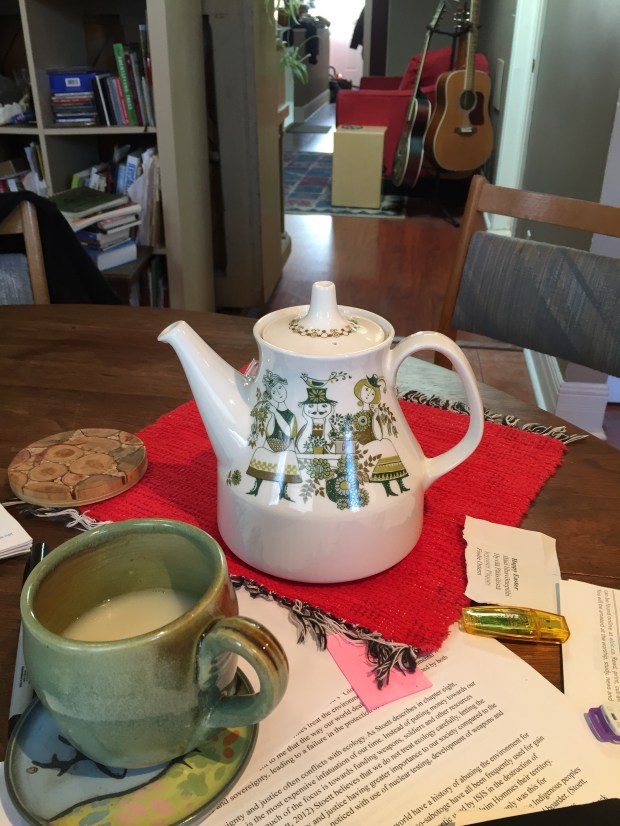
Norwegian teapot

This last week I was in a used-items store in Verdun when something on one of the tables caught my eye. It was a 1960s teapot, white with green figures in peasant costumes. There was a man and two women at an outdoor picnic. I loved the design – in fact, it looked kind of familiar. I picked it up. Underneath was stamped: made in Norway. Wow, I thought. Norway. Right here in Verdun! I don’t remember this particular teapot. But given the fact that I was a child in the 60s, and with all the Norwegian-background families I grew up around (my church was called ‘St Olaf’s’), it wouldn’t be at all surprising that maybe I’d seen that exact design before. Definitely something from my past.

I loved it. So I carried it to the clerk at the cash.

Oh, she said, with a funny expression. I was wondering when someone would take that. She didn’t look entirely pleased. It’s one of my favourite pieces, she went on.

Now. Maybe store owners always say that, to make the customer feel good. But I don’t think that was the case here. She turned it gently in her hands and looked at it again. This one, she said….This one deserves a good home.

Well, I told her. I see it’s made in Norway. My grandparents came from Norway, and my father’s first language was Norwegian. She brightened a bit at that. Not that I’m all that Norwegian myself, I hastened to add. But I will DEFINITELY appreciate it.  At that she smiled. We had a little back and forth about what it’s like for her to go out looking for items, to spend time and attention and care on things and to have them in her store, just to have someone come along and take them away again. She wrapped the pot carefully and almost reluctantly handed me the bag. There, she said, I hope you enjoy it!

I will, I answered.

Then, just as I turned to leave, she blurted out again: make sure you take good care of that teapot. I want to hear that it’s in a good place.

Don’t worry, I reassured her. It will be!

All that, over a teapot. Don’t get me wrong. I’m already quite attached to it. But the teapot, and the fact that two sensible human beings were both so worried about giving a home to this inanimate object proves one thing: everything we do, we human beings do within a web of attachments, memories, hopes and desires. Life is never just a question of functionality. We’re so biologically and spiritually wired for contact and attachment that even a teapot – and the memories and culture and symbolism and life and expectations attached to it – can be important. You are with me, says the twenty-third psalm. You anoint my head with oil (which means – you call me your special one, the one YOU turn over in your hands and say: this one deserves special care and attention). You prepare a table before me in the presence of my enemies. You cancel all my appointments, and make me breathe and wipe the worry off my forehead  and anoint me with oil. And you do this in Mosul and Montreal and Attawapiskat. Whereever the need for justice and care are the greatest. Maybe the best and most valuable thing about shepherds, especially in light of what Jesus says in the Gospel, is simple. Maybe it’s just that a true Shepherd is always THERE. To relax in the presence of, to be oneself with. To be cared for. Like one is with a really great teapot, full of tea.

Life After Normal

IMG_3772

photo: Matthew R. Anderson

‘Do you love me?’ Jesus challenged Peter. ‘Lord, you know that I love you.’ ‘Then feed my sheep’.  ‘Simon, do you love me?’ A second time. Peter, wondering why again the question: ‘Lord, you know that I do.’ ‘Then feed my sheep.’ And again: Jesus being a bit pushy. ‘Simon, do you love me more than anything?’ Big Peter, stung now, maybe turning red, and being a man of quick temper maybe a bit angry: ‘Lord, you know everything. You know that I love you.’

And finally, only then, Peter, always a bit dense, realizing too late what the importance of the number three was. Precisely how many times he’d betrayed Jesus. That’s a whole new kind of hope and life. It’s truth-telling, and repentance. It’s surprising, and life-GIVING rather than life-taking. As if all the hidden,  bad banks in Panama we’ve been hearing all about were suddenly to open their books and say: okay, now all of this money can go BACK. Take it. Take it back, back to the hospitals with their peeling paint and the falling down elementary schools that governments couldn’t keep open, and the health care workers being paid minimum wage, and the veterans who aren’t being given payments. All those austerity measures so the rich could get richer. Take it BACK! Let this wealth create life rather than destroy it.

John Mellencamp sings: “Life goes on, long after the thrill of livin’ is gone.” Sometimes, there’s just no going back to normal. The Gospel of the resurrection is the sacred word that sometimes we shouldn’t even try – because normal wasn’t right to begin with.

The resurrected Jesus stands on the shoreline of our lives, calling out to us in our little boats. Don’t go back to normal, he shouts out. That’s done, now. You can grieve it, if you need to, but it’s gone. Come sit, and be quiet, and have a little something to eat. And then together, let’s talk about what you’ll do next, now that things have changed. Let’s sit and think and ponder whatever resurrection is needed in your own life.

The Curious Unrecognizability of Christ

 IMG_4583

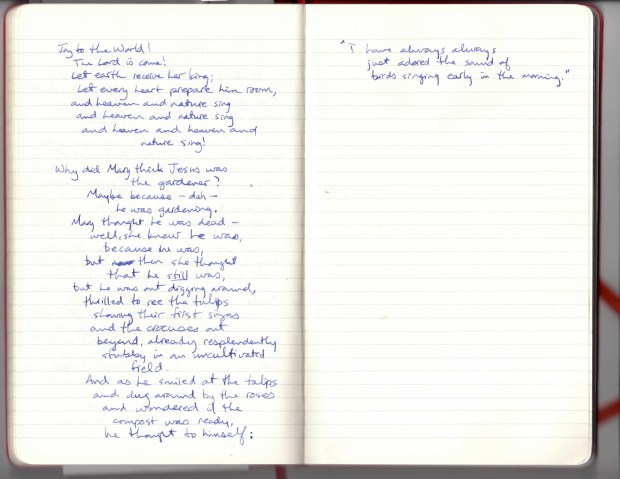
It’s always bothered me. In John’s version of Easter, Mary, when finally she turns around and bumps into Jesus, thinks he’s the gardener. Isn’t that a more than a little bit strange? I’m sure I’m not the only one. After all, we know who’s supposed to be Jesus. And unlike us, Mary was there. She’d known Jesus. But she sees him at the grave and – very strange – instead of being overjoyed doesn’t even recognize him. She thinks he’s the gardener. That just doesn’t make sense. It had only been, what? Thirty-six hours?

The whole thing is weird. Despite church tradition the first (human) words from the resurrection aren’t really “he is risen”. The first words from the resurrection are really “who are you?” Not an assertion, but an ongoing question, the same one we’ve been asking 2000 years.

Maybe it was the shock. Maybe it was Mary’s grief, blinding her to the man standing right in front of her. Those are all good, rational arguments. But for me, there’s another, more interesting possibility.

Maybe, I wonder, maybe new life ALWAYS changes our appearances somehow. Maybe the kind of passage from death to life that we celebrate strips away everything, like a fire, and only leaves the real person that the Creator intended. Including with Jesus.

Maybe reality is upside down, and it’s not that the resurrection isn’t real so much as what we’re living right now might not be. Maybe it’s not so much that we change, but that, given enough love and time, and perhaps some divine intervention, we become, if we’re lucky, who we really are.

Imagine being a tadpole. Your whole life has been in a pond. All you know is water. That’s the limit of your comprehension. And one day, your close friend, another tadpole, disappears. You think she’s gone, but she’s just following nature, which means that there’s a resurrection of a sort going on. She’s changing into the adult. A toad. Something all of you tadpoles don’t even suspect exists, even though it’s coming for all of you. Then, one day, from somewhere, somehow, into the water dives this magnificent creature from beyond. Not a tadpole. Something completely different. And yet you sort of recognize her. If that happened, it would alter everything you believed about reality, there in the tadpole world. Maybe Jesus became who he really was, who we will ALL someday be, only by going through the suffering he did. That’s certainly is the case for other people. I can safely say that at 56, my sufferings have changed me, and I know I’m not alone.

Easter doesn’t mean life eternal. It means life after death – or maybe better, through death. The spring of our lives is upon us, but there will never be a spring without a winter, and every winter, no matter how hard, carries spring in its bosom. Northern Europeans know that well enough. May God give us the eyes, and the hope, and the expectation, actually to believe, see and trust in THAT kind of resurrection.