ELCIC

Love Love Love Love Love, Actually

“Funeral held yesterday for La Loche shooting victim” CBC News.

“Over 40 dead after migrant boat sinks off Turkey” Huffington Post.

“Increasing concerns over Zika virus is changing tourism patterns in Central and South America” CBC Online.

“Thousands of complaints about the behaviour of physicians lead to very few cases of discipline” CBC News.

If I speak in the tongues of mortals and of angels, but do not have love, I am a noisy gong or a clanging cymbal.

“Nova Scotia winter storm leaves thousands without power this weekend” The Gazette.

“Scientists find genetic link to Alzheimers.” The Daily Telegraph.

“Genetic law urgently needed to keep insurance and other companies from discriminating against those with previously hidden flaws, says watchdog” Yahoo Canada News.

And if I have prophetic powers, and understand all mysteries and all knowledge, and if I have all faith, so as to remove mountains, but do not have love, I am nothing.

            “Republican candidate Donald Trump says he’s looking forward to Iowa debate.” PBS Public Radio.

“Man in Oshawa Ontario legally changes his name to ‘None of the Above’ so that voters can choose ‘none of the above’ in the Ontario provincial byelection soon to be held there.” CBC News.

If I give away all my possessions, and if I hand over my very body so that I may boast, but do not have love, I gain nothing.

“Love is patient, love is kind…” We really know those words. They’re some of the most famous from the Bible. Thanks to weddings, even people who never go inside a church know these words: “Love bears all things, hopes all things…” However, they don’t much sound like words from the news. “Love is not envious, or jealous or boastful…”

Love, love, love, love, love. Saying it is all very pretty, but when you get right down to it, what does love mean? This is a bit of a problem when it comes to actually applying what Paul has so beautifully expressed.

He wrote: “Earnestly desire the higher gifts”. And we should answer: of course! The problem is, love isn’t something any of us actually disagrees with. I mean, EVERYBODY thinks love is good. If we hired a survey company to phone a thousand people and ask them about this, 990 would all say the same thing – that yes, love is a very, VERY good thing.

And Jesus too said it: Love one another as I have loved you.

But do we or can we even agree on what this ‘good thing’ actually looks like? How we live it out? Practice it?

There are least two quite different ideas about love. We’ve probably agreed with both at one time or another.

Number one assumption about love is this: we tend to love – and SHOULD love – what we’re used to. As in, only someone like me who grew up in Saskatchewan loves that desolate prairie landscape. Or more seriously: if you were a child who was abused or beaten by your dad, how could you ever come to love a god who sometimes goes by the name “our Father”?

This is what we could call the “natural” ideal of love. We love as we’re able. Love is one of our self-expressions, and as such it is limited by our experiences.

So far so good.

However, there’s ANOTHER idea about love, and it can’t be stressed enough that this second idea about love isn’t the same. In this idea, love doesn’t necessarily come OUT of who we are and what we experience. Rather love goes INTO who we are and what we experience. In other words, if we love in ways that don’t necessarily come naturally, perhaps what is natural for us will change.

Consider again Paul. The guy who wrote: Love is patient and kind.

Paul? Anybody who’s studied the man knows that patient and kind are not the first words you’d ever use about Paul. It doesn’t sound much like the sarcastic apostle who told his opponents in the book of Galatians that if they wanted circumcision so badly they should just go all the way and castrate themselves. Frankly, he could be quite nasty at times. It sounds to me a bit like Paul was hoping someday he might live up to his own words.

But would that be so bad? Maybe, instead of love being what comes naturally, sometimes love has to be what is actually a stretch.  Most of us can be, and often are, basically kind people. But it’s harder to be loving and caring about some Christian we don’t know, who speaks a different language and has a different culture, who is a refugee from Syria. Or, even more, the Muslim refugee from Syria. That’s the kind of love that takes, not just a natural rush of sympathy, but several days or weeks or months’ worth of conscious caring.

Sometimes we get the idea that the opposite of love is hate. We’re wrong. The opposite of love isn’t hate – it’s caution. It’s half-heartedness, fear, and distance.

Maybe, if we think biblically, we’re cautious of the kind of love Paul describes because we realize, down deep, that to love that way might be the end of us. Literally. Like it was the end of Jesus.

Since we ALL say we believe in love, we’d better know what it is we’re agreeing to. Paul leaves no doubt. Real love, he says, follows Jesus, who was not scared to show it. Real love results in the destruction of the old self and in the creation of a new self.

Love, in other words, is scary.

And that, as it turns out, is exactly how God loves us. Despite our faults, despite our failings, despite years and years of minor or major betrayals, there is a hidden subject behind this passage. Our Creator still bears all things, hopes all things, believes all things, and endures all things about us.

You and I are called to learn to love as does our Lord. Not as we can. But beyond what we can.

And these three remain: faith, hope, and love. But the greatest of these is love.

Paul Did Not Convert

St Paul at St James church

In the calendar of the western church, today is the feast-day of the Conversion of St. Paul. This is a bit of a problem. Especially, it’s problematic for any Christians who happen to be biblical scholars. It should be a problem for everyone who still marks this day. It’s pretty much accepted, now, at least in academic circles, that Paul didn’t convert. That is, on the road to Damascus, whatever happened to the extremist Saul of Tarsus (between horses in the paintings, no horses, voices from heaven, no voices, scales on his eyes and assorted other details one can take Acts to task for, since Acts repeats the story several times with variations) Paul didn’t stop being a Jew and suddenly become a Christian. Perhaps the easiest objection is that he couldn’t have! There was no such thing as Christianity for Paul to be converted to.

But there are other, more substantial issues. For one thing, in his own writings Paul never says he converted. Rather, he presents himself very much like an Old Testament prophet, called by the God of Israel (not some new deity but the one Paul knew all along), to proclaim that God’s Messiah, Jesus. The fact that so many Jews in Paul’s own day didn’t think Jesus was the Messiah is, in this case, beside the point. All of them were thinking of Israel’s God, no matter their disagreement on whether that God was, or wasn’t, responsible for the crucified teacher from the Galilee. Paul was a Jew, a Jew who believed with every molecule in his body that the Messiah had come, and that Israel’s God was about to change all of human history. In what he believed was the world’s defining moment, he thought his particular task, as a faithful Jew, was to invite the non-Jews into the family of Israel as they were, as non-Jews.

So Paul was not a Christian. This, by the way, is the title of Pamela Eisenbaum’s book on the subject. Perhaps there will someday also be a book with a title something like “Paul is not a (contemporary) Jew”. Judaism, like Christianity, has changed since the first century. Both contemporary Judaism and contemporary Christianity are children of a heterodox first century faith that no longer exists.

Paul once wrote: “I have become all things to all people”. Well, he got what he wanted. Paul has been made and remade so many times in our images it’s hard to know what he ever really was. The poor apostle’s been co-opted by supercessionists, by gnostics, by anti-semites, conservatives, liberals, sceptics and humanists alike. He’s been promoted as everything from the first liberated male of western religion to the one person responsible for everything bad about Christianity. The truth, as always, is probably not just in between, but lost, lost somewhere way back there, in the first century. However, there’s one thing we can be fairly certain of on this Feast-Day: whatever else he did, Paul did not convert.

Paul statue

For now just carry the water

Image result for Orit Shimoni

This last week a friend of mine, Orit Shimoni (http://www.oritshimoni.com/), came to town to perform. She’s also sometimes known as Little Birdie. Years ago she did graduate studies at Concordia, which is where I met her. Now, she tours all over the world playing her music. The place she sang at last Wednesday was a café on Cote-St-Luc road (not very far from here). It’s a small venue – fits maybe thirty people. She did the set with just a guitar and nothing else, so the words were really clear. Orit’s got kind of a theological bent to her music, which is one of the reasons I like it. One set of lyrics in particular struck me. It was about Cana, sort of.

Apparently, in Cana, in Galilee (that is, in the north of Israel), Jesus and his disciples were attending a local wedding. During the reception, more by chance than anything, Jesus performed his first miracle. He turned water into wine. But for her song Orit turned the words around. “If I could turn wine into water,” she sang, “you would not be alone.” Wine into water? What did she mean? “If I could turn wine into water,” she sang again, “a path to you I’d find.”

Oh, I thought. Oh.

There’s a tragedy behind that song. I didn’t ask her, but I think it’s about alcoholism. Orit sings a lot of sad songs, and songs with bite. But this one in particular has a ring. IF I could turn wine into water. Meaning: I can’t. And even though I don’t know the details, and I don’t know if it’s even about Orit: whoever that song is about couldn’t make a miracle. That’s what the song is about. That person couldn’t stop the alcoholism. Couldn’t turn wine into water.  And so now, instead of singing about a happy future, the song is about regret.

Makes for a great song. But a sad memory.

In the Bible story, the bride and groom, in fact, the whole wedding party, are headed for a disaster. Not an earthquake, ice-storm, tsanami kind of disaster. But the small kind of disaster we all run into every day and all hate: a major glitch. A screw-up: the wedding reception was about to run out of wine.

Now. This is not the worst thing that could ever happen. But if you’re the bride and groom, or the person responsible for the reception, it’s bad enough. No wine means unhappy guests. Probably guests leaving. So it says that Jesus’ mother stands up from where she’s seated, and makes her way over to see him.

The writer makes it clear that Jesus and his disciples were at the wedding in Cana, NOT to face any tests, but just to enjoy themselves. It’s not even clear if Jesus knew the wedding couple. I imagine in the hills of Galilee, it might have been a bit like some Italian weddings I’ve been to, where the whole neighbourhood is invited.

In any case, when we meet him Jesus is off in a corner, well-hidden. He’s out of the spotlight and wanting to keep it that way. But then the wedding runs out of wine.

Mary’s clearly a mother who knows her own kid better than he seems to know himself. She comes to his table and announces: “they have no more wine.” As if the next step is obvious. “They have no more wine – now, do you want to leave your own mother without a glass of Chardonnay?” Quite naturally, Jesus responds: “what does that have to do with me?” I love that. This is NOT the pious, angel-faced, head-upturned or downturned Virgin Mary we see in statues so often with her hands clasped meekly at her side. This is a tough Jewish mother who knows what her son is capable of, and won’t take no for an answer.

You would think that the Lord speaking should be enough for any human being. But no. Mary ignores Jesus completely. The Son of God, the Lord of Life, and what does she do? She goes back to her own table. And tells the servants: “do whatever he tells you.” She KNOWS he’s going to fall in line! The fact that the Bible treats a lack of wine as a disaster is already interesting. But that’s NOT the main point. The main point, at least in my thinking, has to do with the water.

You can imagine Jesus sighing and shaking his head. Once a kid, always a kid, even Jesus. Do you see those stone jars over there, he tells the servants? Fill them to the brim with water. Then, he says, go, take a jug, and fill it up from those same stone jars, and take it to the chief steward.

And so, timidly, one of them does.

This is where you and I come in. You and I are that one scared servant. Like the woman my friend Orit was singing about, you and I don’t have the power to do miracles. If we could, we would.

All we can do is carry the miracle. Every time we get together, every time we pray, and especially every time we go OUT in Jesus’ name and try to do something for the world, we’re the poor, terrified, uncertain servants. Just like at Cana, it’s all simple stuff – water, bread, wine. Or maybe in our cases, it’s a hug, or a song, or an ear, or a moment’s time, or a few dollars, or a few words. Now draw it out, Jesus tells us, even though it looks like simple water, and take it to the world.

So. If we’re faithful, if we’re trusting, and more often than that, even if we’re doubting, we do that. We draw the water out of our unremarkable, unmiraculous lives. Because ultimately, THAT’S ALL WE HAVE. Then we go. We carry what we fear might be way too ordinary, to a world that doesn’t expect or believe in miracles, but like the wedding guests need them just the same. And if it turns out that the water is just water, then, like St Paul said, we’re the greatest fools of all.

It took faith for whoever that first nameless servant was, to take a jug of what he or she was pretty sure was worthless, and take it to the head steward of the whole feast. And it takes faith for you and I to do OUR simple commissions, with our simple lack of resources and abilities. But we have to. That’s what we’re supposed to do. That is how we will be judged.

And just in case you and I think we have nothing to offer, we should think of the news story from CBC this last week. Did you hear about it, or read about it? There was a fourteen year old kid who was begging on the street, saying he was homeless, and in the midst of that terrible cold of this past week, although a few folks gave some change, guess who was the ONLY person to stop and offer this kid a coat – in fact, the coat off of his own back? The only person to help was another street person, an Inuk man, Putulik Kumaq, originally from Nunavut, but homeless on Montreal streets for the past 17 years. It turned out that the 14 year old kid was doing a school project and was being filmed secretly by his brother, which is the only reason we know about this selfless act.

Anytime we say we have nothing to give, we can remember the servants, who were just asked to carry water, and we can remember Putulik, who said “it’s cold, and I had a feeling he needed help”.

On the third day, it says, there was a wedding in Cana in Galilee, and here, amid the food, and drink, the visiting and gossiping and the stuff of life, Jesus did the first of his signs.

Wine from water is just the beginning. That is the real point. In your life and mine, wine from water is nothing, compared to what our Creator can do. You are carrying miracles, if only you know it, says the Creator of singers who come to Montreal, of street people and poets, of Putulik and Paul, and of you and me.


To see Orit playing the song, watch:

To hell and back

highway hearse 2014

I went to visit a parishioner in the hospital once and was completely thrown by what I discovered when I walked into her room.

Maybe I hadn’t been paying enough attention. Someone had told me what this woman was in for, I remember that. But I’m afraid it had gone straight in one ear and out the other. So when I walked into the hospital room, I was surprised to discover there was no bed. Instead there was this thing in the centre of a large space. It looked like some kind of miniature circus ride. Or a space-ship pod, or a climbing frame or something.

Hello? I said, tentatively. I stopped in the doorway. Was I in the right place? Then from the middle of the tubing and bars I heard the small voice of my parishioner: “hello….I’m down here.” I peered closer. Near the floor. And there she was, strapped right into the middle of that contraption. Hanging upside down.

I walked up to it. There was a bed there, all right. I could see it at this point. But it was an upside down bed. There was also a chair beside it. When I sat in the chair I couldn’t see the woman at all. It’s called a Stryker frame, she informed me dryly, while I sat down, got up again, and then kind of wandered in a circle around her, looking for some way I could actually make eye contact. Are you having trouble, pastor?

Obviously, it should have been me asking HER this question. But there we were. I have a spinal cord injury, she told me, while I dithered and fidgeted. I’m going to be in this thing a month, at least. My poor husband’s stuck at home working his job and taking care of three kids. We’ll be lucky if we’re still together by the time I’m out of this thing. You can stop shuffling around like that. She sounded annoyed. I’m not going anywhere.

I stopped shuffling around.

Are you okay? She asked.

I’m okay, I answered her.

Well, I’m not, she said. Welcome to my own personal hell.

Now when all the people were baptized, it says, and when Jesus likewise had been baptized and was praying, the heaven was opened, and the Holy Spirit descended upon Jesus like a dove. And a voice came from heaven: “you are my son, the beloved, with you I am well pleased.”

So pleased, apparently, that God would lead this Beloved Jesus, also, to his own personal hell, tortured and dying, on a cross. Someone once said: beware of being one of God’s favourites. It gets you into trouble every time.

And when you think about it, isn’t that true? Martin Luther would’ve been burned at the stake if they could’ve gotten hold of him. Or Martin Luther King, shattered with a bullet for speaking up for justice. Or Thomas a Becket, run through with a sword right there, on the steps of his altar. Or Saint Paul, persecuted and ridiculed and shipwrecked and murdered. Or any of a thousand Syrian Christians right now, in a country that was one of the first blessed with the Gospel, fleeing desperately to save their lives.

With you I am well pleased. That’s what the voice said to Jesus when he was baptized.

It’s an odd sort of pleasure.

In trying to understand the mystery of why Jesus was baptized at all, I think about the woman in the hospital, who told me she was in her own personal hell. Or the comment I saw on Facebook yesterday, congratulating another woman on her first cancer-free diagnosis. After five years of hell, said the Facebook post, finally free!

Yes, I think. I understand hell, when you put it like that. Probably all of us do. Certainly any of us over – I don’t know – 40 years of age. You don’t make it that far without a few cuts and bruises: cancer, divorce, separation, child problems, parent problems, dreams lost, dreams found. Who knows? Life, we eventually realize, isn’t what we do when we’re not suffering. Life eventually becomes, more than we might think, the ways in which we DEAL with suffering. Live through it. Rise, not above it, exactly, but with it. Sometimes, even, because of it.

So maybe the baptism of Jesus makes sense if we think of baptism, not as something that leads away from suffering, but something that leads straight through it. And then, if that’s it, the fact that Jesus was baptized means that he was willing to take on, willingly, the kind of voyage into hell that the woman in the Stryker frame was talking about, or that the Facebook post person was just getting over. The human condition.

I felt like such a fool for the first few minutes I was visiting that woman in the Stryker frame. I just stood there, towering over her while she complained bitterly and then cried about what she was going through. I felt completely out of place, awkward and embarrassed. It took me forever to realize the simplest thing: that I didn’t need to be standing at all. Eventually, when the nurse came in, she found me where – if I’d been sensitive enough to realize it – I could have been from the beginning: on my back, on the floor, parallel to the bed, looking up at this parishioner. Sharing her perspective.

What really pleases God, it turns out, is solidarity. That’s what the baptism of Jesus is probably really about. For Jesus emptied himself, Paul writes, taking on the form of a slave, and in that form – on the floor, lying beside our human suffering, he became obedient, in love, to the human condition, even death on a cross. Only then was he raised. Like Jesus, it will be for us only when, trusting in the compassion and community we see in the cross, and finally beginning to understand this strange way of being God’s favourites, that we too, through death, in solidarity with the one who went first, will know what it means to rise again.

Which Star We Follow

De L'eglise after snowstorm

It’s January third. And I think it’s safe to say that this year, there’s not a lot of optimism. New Year’s Eve I was at a small dinner party. One of the people there had prepared some lovely cards with questions on them that went around the table and we all had to answer. When the questions were about last year, each of us shared warm memories. It was great. Lots of laughter. But then came the question: “what significant happenings do you expect on the world stage in 2016?” And all of a sudden, you could feel the chill. Each of us had wonderful recollections of the year past. But most of us were quite apprehensive about the year coming. War, violence, financial crisis, disease, climate change, breakdown. One after another we laid out forecasts of doom. That’s what we saw in the stars.

When the Magi heard the king, it says, they set out; and there, ahead of them, went the star they’d seen at its rising.

Apparently, not all stars say the same thing. At our dinner party, we saw bad things. Trouble, and difficulty, and pain, and disaster, despite our fairly rosy personal stories. But according to the Gospel of Matthew, the magi also followed a star, right to the Messiah.

So which is it? Will our coming year be guided by a star of great difficulty, or a star leading to Bethlehem? Which ways are we being led?

Epiphany is such an important moment that every year it surprises me we don’t make more of it. It’s huge. If it wasn’t for Epiphany, there’d be no Christian faith, as we know it. Without the kind of trip commemorated today, those of us from European ancestry, at least, might still be worshipping the god of some oak tree or other in the vast, dark, northern forests.

To put it another way: Jesus was born a Jew, lived a Jew and died a Jew. That is fact. Insofar as anyone in his day believed he was a Messiah, it was a Jewish Messiah. “Born to set his people free” as the old hymn says, emphasis on HIS people. That we who are non-Jews got in on the Jesus thing is actually kind of surprising. If wasn’t God’s plan – which of course, Christians believe it WAS – then it’s one of the greatest ironies of history (as Nietsche believed!). Christianity is what happens when Israel’s Messiah comes and everyone believes it BUT Israel.

We Christians are not the originators of the Christmas story. And we’re not even its first and most important recipients. Yet, according to Matthew, we were at least invited to the party. How do we know this? Because of Epiphany. Because of the Magi, the first non-Jewish worshippers, following the star to find the baby, born in Bethlehem.

So the very first image we get of our own spiritual ancestors is that they were pilgrims (which is, of course, great for me to be able to say!). They were outsiders, and foreigners, and seekers. They were also a little bit lost.

I started out asking which star you thought this year might be hanging in our skies: a star of difficulty and danger, or a star leading to the love and transformation of the Christ child. The irony is: they are probably both the same star. And isn’t that a pretty good description, maybe, of who WE should be, following it? Pilgrims, outsiders, foreigners, and seekers – despite often being a little bit lost.

Tree Lot on December 23

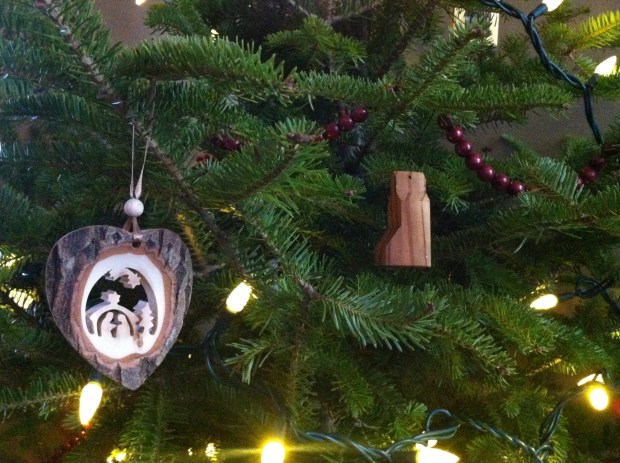
German ornament copy

Maybe one of the saddest things you can do, the evening of December 23rd, is to stand on a sidewalk and look at a Christmas tree lot. It’s like peering into the fairy-tale ballroom after Cinderella and the Prince have left. You see the evidence of something magical. But no actual magic. And no people. There are tags strewn about, needles stamped into the earth, bits of twine here and there from the wrapping machine, placards wired onto the fence advertising the prices– scotch pines, ten dollars a foot. A Big “Merry Christmas-Joyeux Noel” still stencilled on the entrance. But the party’s over. All that’s left is garbage.

Which is why it’s doubly hard to see a tree, on such a lot, hours before Christmas. A tree that apparently, no one wanted. I empathize with those trees. On the lot by the church in my neighbourhood last night, it was dark. The speakers on the lightposts in Verdun were still playing Christmas music: Jingle Bell Rock and Bing Crosby crooning White Christmas. But on the lot, the lights had been put out. A half-dozen trees leaned forlornly against slat fencing. No one even bothered to guard them– the gate was wide open. You want a tree? Go on in and take one, someone would have said. If someone had bothered to be there.

The trees, so valuable just a few days ago – are now for the asking. The problem is, no one’s asking. The bubble of Christmas tree speculation – if we can call it that – bursts somewhere during the evening of, probably, December 21st. A Christmas tree alone on Christmas Eve is as unwanted as a turkey after Thanksgiving. Worse, actually. Because at least a turkey can stay frozen. People get hungry again. No one gets the urge for a Christmas tree in January. Not even a beautiful ten-foot balsam fir. And because they’re cut, the tragedy is, no one can replant them. These living creatures have been sacrificed for absolutely nothing. Actually, less than nothing. They’re a liability.

So there I was, my hands full with last-minute groceries, looking into the lot, hearing the carols, and thinking about Christmas. And abandonment. I was remembering all the times in my life I’ve felt like one of those trees. The times I’ve been at some conference and realized that all the important people around me were being taken up, disappearing one by one into conversations, lunch-plans, networking, wanted for their value. And I was left behind. The times, so many years ago, when I was a teenager, when I sat at home alone, my social capital less than nothing. Times have changed, in my life. That’s not true anymore. But my memories still remind me what that’s like.

And then I thought about my students. All those young people, on the day they start CEGEP or college, trying so desperately to figure out what might get them a job five years down the road. It’s such a crap shoot. The stakes are high. Some of them will get it right. They’ll be the ones snapped up like the premium Christmas trees at the beginning of December. Many of them will get it partially wrong. But they’ll get picked up just the same, like the tree that’s a bit quirky but just right for that family in the small apartment, or the one that’s sold for a few dollars less. But after that, a few students will see the promise, feel the action so close but so far, and for any number of reasons, they will be passed over. They’ll wind up like these trees. Those are the people I said a prayer for, standing there.

Then I thought about Luther. Because doesn’t a person automatically think about Luther, looking into a Christmas tree lot?  Luther LOVED the Nativity. But he said, and I quote: the birth was pitiful. There was no one –those were his words: no one – to take pity on this young wife who was for the first time to give birth to a child; no one to take to heart her condition. She, a stranger, did not have the least thing a mother needs in a birth-night. There she is without any preparation, without either light or fire, alone in the darkness, no one offering her service. Luke says, in describing Jesus’ birth, that the family was painfully unwanted. Desperate.

And then I thought about my tree, in my apartment. With its lights it glows in the dark and makes me feel warm just looking at it. On its branches I’ve placed the memories of so many beautiful places and people and encounters. G’s friend came for a visit yesterday and said it smelled great. These trees, I thought, looking at the ones scattered and alone in the dark lot – they will never have that moment of beauty.

As I was standing there, a young man who had been loitering across the street from me, under the awning of the metro, sauntered across, hands in his pockets. He looked in at the trees, like I was doing. I thought at first that he had come to ask me for change. But he ignored me. To my surprise, he stepped right past me, into the lot, and up to the abandoned tree I was looking at. And suddenly there was an old truck there, pulling up to the curb, and other young people, two bearded fellows and a woman, gloves on. As I watched they began to load the trees onto the back of the pick-up.

Wait a minute, Hey, wait! I called out to the first kid. What are you doing with these trees?

We’re rescuing them, he answered, with a smile.

What do you mean?

If we leave them they’ll just go into some landfill. The City has a recycling program, but they don’t come here. So we’re taking them. Why? Do you want one?

No.

He shrugged, Okay. Better for us. We can use them. These ones are the best. They’re not plugged up with tinsel and all that other crap (actually, he didn’t use the word crap).

What do you do with them?

The young man evaluated me, but only for a second. With my hands full of shopping bags, and my Anglophone accent, it was pretty clear I wasn’t some sort of city authority.

We take them to our farm, and we grind them up, he answered. Well, not all of them. The really misshapen ones we use as bird-feeders. They’re perfect, like this guy here – he indicated one particularly straggly, ugly tree. We’ll hang bags of suet from his branches and the birds will just love to make a home in him.

The other ones – he nodded to the rest – well. He hoisted one in his hands. They’ll give their wood to mulch and their needles to the strawberries. They don’t make good Christmas trees. But they’re far more valuable for us. They’ll help new life grow, by sheltering the berries under their needles.

And then the fellow jumped in, and the truck took off, and I was left alone again. And I stood there, on that sidewalk, in the dark, and I thought about Christmas again, and about the angels above the hills of Bethlehem, and what it was they were actually singing to the shepherds. About a God who picks out – and picks up – ESPECIALLY the unwanted and the abandoned. The ones left behind. Who uses even that, even loneliness, and death, and injustice and oppression and the stripping away of beauty, as a way of bringing new life to the world. Who has never stopped, as it turns out, being the Creator. And I realized that there is more than one way to be noble. And many ways to be of service. And that the true message of Christmas is in a refugee child, leaning against a fence, forgotten but not alone, whose life means hope and whose death shelters new life, again and again, always Christmas. Always, evergreen.

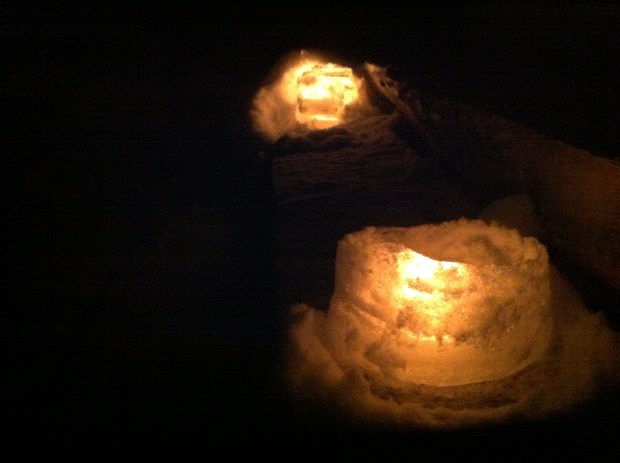
candles in the snow

Who’s Missing at Christmas

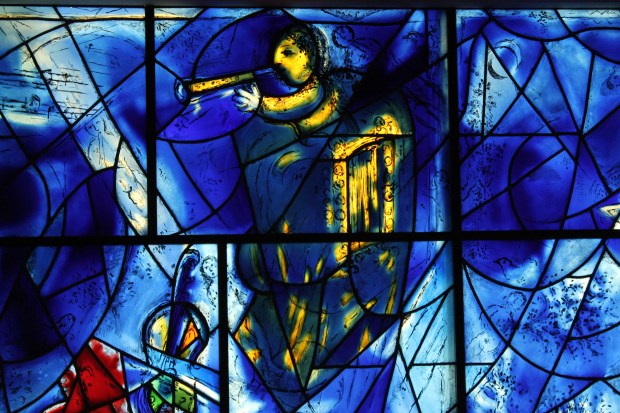
Chagall Chicago Art Inst of Design

I have a confession to make. I haven’t made a parcel for my son D. yet this Christmas. This has been on my mind a lot the last few days. I haven’t gotten something together and baked cookies and wrapped up little reminders of home and sent it all away via Canada Post. Christmas morning will come, and way off in England somewhere, D. and his girlfriend E. will wake up, and brush the sleep out of their eyes, and get some fresh coffee, and stretch and yawn, and then they’ll sit and open presents. And there won’t be anything from Daniel’s pappa. Me. And the worst part is: it’s too late now. I could make all kinds of excuses: it’s final exam marking time, there are so many emails going back and forth about the Finnish and Estonian churches, the research for the book on pilgrimage is taking too long. Things were crazy-busy at the university. All true. But really, is any of that an excuse? I just haven’t been paying enough attention.

At this time of year, one of the questions that comes up, in very many families, is who will be missing this Christmas? We don’t just decorate the table – we start to think about who will be around it. And who won’t. Sometimes it’s because of a death. This is the first Christmas for me without my mother. Some of you have lost loved ones in the last couple of years. You know how hard that is. Sometimes it’s because of distance, as it is for me with my middle son. Sometimes it’s for other reasons. Children grow up and go to their partners’ parents, or have Christmasses of their own. Sons or daughters, or grandsons and granddaughters, are off at school, or away traveling. Maybe there’s been a rupture in the family. That’s especially difficult it seems, at Christmas, in what is supposed to be a season of love and forgiveness. There’s a reason that this is also the season of greatest depression and anxiety. “I’ll be home for Christmas” isn’t just the title of a song. It’s a feeling we have in our heart. It’s an urge, almost instinctive, to be home, wherever we feel home is. It’s an unconscious, powerful urge to gather in loved ones under our wings.

One of the ironies of Christmas, is that that warm, family, clannish keeping track of who is home and who is away is actually not very Christmassy. If, by Christmas, we mean the first one.

The first announcement wasn’t about pulling the family all together. It was, instead, about expanding the very notion of family. Blessed are you among women, cries out Elizabeth, as if she can’t help herself: and blessed is the fruit of your womb! Why? Because Jesus was going to help his family? Actually, no. As it turns out, he was about to tear his family apart. And a sword will pierce your heart also, the old prophet Simeon warns Mary about her future. This kid will be trouble. But for humanity – well, that was something different. This child was born to expand the whole concept of family, to include, in the sense of all the prophets of Israel, all those people traditionally left out.

God’s mercy is for those who fear him from generation to generation. NOT the rich. Not the upper-class. Not the influence-peddlers and intellectuals and business-people. For the mighty one of Israel has brought down the powerful from their thrones, and has lifted up the lowly. God has filled the hungry with good things – even better than a Canada Post box from home – and God has sent the rich away empty.

Who is missing this Christmas is an issue that has to do, not with sentimentality and longing, but with who we see and who we ignore.

Christmas, according to Luke, is NOT about happy faces around a table where everyone is related to us. We know that. Of course. But it bears repeating. Christmas is much tougher, and more real. It’s about raw power. It’s about justice, and injustice. It’s about how much a cup of coffee costs, and who manufactures our shoes, and whether some government committee paid for by our taxes cuts funding for social programs. And God’s choice, this Christmas, is as it was the first Christmas, is NOT for US. It’s for the refugee, and the migrant, and the outsider, and the poor, and the working poor. God chooses to lift up, not the rich, not the happy, and not even the middle-class. God’s incarnation was and is, to lift up the lowly.

Blessed are you among women, says Elisabeth. Because God is doing something important through you. In you, God is already lifting up the lowly, and remembering the long-standing promise.

Mary is, in a Biblical sense, the spoiler. When you think about it, she’s a lot like the whole Biblical nation of Israel wrapped up in one person. For just as God once chose a weak, insignificant nation of slaves, so God once chose a weak, insignificant girl.

Firstly, she was a girl. At a time when women were property only one step up from the furniture, God chose of all people, a woman. In addition, she was young – we don’t know quite how young, but young. And finally, she was caught in a scandal, in a society not so different from the societies today where a young woman in Mary’s place would be murdered brutally by her own family for so-called shame of getting pregnant.

This was the one God chose as the theotokos, or: “God-bearer”. My soul magnifies the Lord, and my spirit rejoices in God my Savior, she replies to the angel. For God has looked with favour on the lowliness of his servant.

The message for us is this. If God chose someone as weak and insignificant as Mary for something so important and powerful, then SURELY God continues to choose the weak and insignificant around us. And we need have no shame when we feel that way. AND: we should be ashamed when we ignore the theotokai – the weak and insignificant – who are the prophetic witnesses to what is important and real in our own world.

In the Paris climate talks that just wrapped up, one of the things we learned is that climate change isn’t just about protecting ourselves. It’s about justice. Because it’s more often than not the poorest who are the first to feel the effects of unstable climate. So climate change is once more, a question of how we work out our faith, or fail to.

In Judea, in Paris, in Montreal, wherever you are, God is in the business of using nobodies to perform powerful foolishness. Like Mary said: “God has brought down the powerful from their thrones, and lifted up the lowly. God has helped this servant, in remembrance of such a great mercy.”

My urge, this Christmas, like yours perhaps, is to bring the family together as much as possible. I want to know who’s missing at Christmas. Somehow to include my son in England. And that’s not a bad thing. But God wants me – God wants us – to think even BIGGER. Who’s missing at Christmas isn’t just the son who isn’t getting a parcel on time. It’s the one who never gets a parcel, the one who waits at the border, the one who lives on a reservation without drinkable water.

What can we do?

We can say with Mary my soul magnifies the Lord, and my spirit rejoices in God. And then we can let justice be born in us. Even when we are nobodies, worth almost nothing, we CAN do that, with love for Christ and for each other. For we are like Mary in one last, important way. When we think we have and are nothing, but we are open to the announcement of the angel, that’s when God can use us most of all.

The Pillars of Paris

Grief in Pere Lachaise cemetery      

      Those of us who’ve been fortunate enough to be to Paris are probably all thinking, today, about that place. A lot of us have memories – often very good memories, of being there. It’s such a wonderful city. But it must have been a very dark, a very frightening place, Friday night. I imagine it still is, with lots of fear and anxiety and grief as Parisiens try to recover from something it’s impossible to recover from. I was there just for four days last February, staying near Pere Lachaise cemetery, very close to where the attacks took place.

The bloody murders of so many innocent people give a new meaning to Jesus’ words: Beware that no one leads you astray. …. When you hear of wars and rumours of wars, do not be alarmed; this must take place, but the end is still to come.

The news Friday felt so apocalyptic. It feels like the end of everything we count on being stable in a society, when gunmen enter a nightclub for the sole purpose of murdering innocent youth. Yes, I know we’ve been spared what others go through regularly. I know that such violence is tragically the case in too many places in the world. Beirut for instance. That poor suffering city. But not Paris, or London, or New York. Or Montreal, we hope. I was busy texting my daughter on Friday night: “where are you?” “are you okay?” We cannot imagine the fear. We cannot imagine the loss, for those parents and grandparents whose children did not come home that night, who now, because of hate, will never be able to come home.

For nation will rise against nation, Jesus said, and kingdom against kingdom.

The borders of France are now sealed. The army is in the streets. Presumably, soon there will be even more cameras, more checks, more eavesdropping and surveillance. The French, like the Americans after 9/11 and like us last year with the attack at Parliament Hill and Bill C-51, are going to be even more willing to give up freedom in exchange for the promise of security.

It’s that word – SECURITY – where the warnings of Jesus really hit home. Jesus was standing by Herod’s Temple, and his disciples were going on and on about the stones. Yes. They ARE great stones. I’ve been there. The stones in the Temple foundations are, individually, the size of city buses. Can you imagine if our buildings were built on solid pieces of granite the size of a Montreal city bus? Not just one but thousands of them? We’d think ourselves pretty secure. In Jerusalem the stones are beviled and cut so carefully that you would think they’re put together with mortar, the lines are so perfect. It is a feat of engineering and strength. Something you would think would last thousands of years. But in the end, did even such a miracle of engineering offer security to the people of Jerusalem? Not at all.

Do you see these great stones? asked Jesus. Not one stone will be left here upon another; all will be thrown down.

Jesus’ point is about security. Where it exists and where it doesn’t. No matter how hard we try. For one thing, he’s telling us, security DOESN’T exist in or through the state. The Jerusalem Temple was the closest thing that Jesus and other Jews in his day had to a state institution. It was grand. It was permanent. But Jesus points out – it’s NOT going to save you. And it didn’t. All will be thrown down.

When we put our trust, as we will, in cameras and guns on the street, and surveillance, we will be saying at least in part we DON’T put our trust in community, and discussion and peace-building and mutual concern and education. We will become, perhaps marginally safer, but at a cost to ourselves. And that’s always the way it is with our attempts to safeguard ourselves. They injure us. Ultimately, in this changeable and dangerous world, Jesus is saying that all attempts to be secure and safe result in our putting trust where it doesn’t exist – in other words, all such attempts end in idolatry. FALSE security.

It was actually the Temple, and the City, and the State, that eventually put Jesus to death. Because the authority of the state ultimately rests on violence as well, even if that violence is systemic rather than a bomb strapped to some deluded martyr’s chest.

So. Where do we find security? Only one place: the place where, paradoxically, as Jesus showed us, security seems the MOST absent. The foot of the cross. Paul wrote: I decided to know nothing while I was with you, he except Jesus Christ, and him crucified. In other words, I will live with complete insecurity, for the sake of love.

Where do we find our peace? It’s not that complicated. When we depend entirely on Love, especially the love that created and sustains us, that’s Gospel. When we depend on threat and power, that’s NOT Gospel. And so police, insurance policies, borders, weapons, buildings – precisely those things that normally make us feel solid about ourselves, are probably the exact things that put us on shaky ground with our God, and with the community of love we are supposed to be trying to build.

In one sense, it’s always about security – where we try to get it, where it fails, and how THEN, we go out and try to find security elsewhere. Paris is terrible, and right now feels unique. Yet there will ALWAYS be wars and rumours of wars, earthquakes, flood and drought. In other words, we’re chasing a dream. We can do what we can do. No more. Try as we might, security will NEVER actually be “secured”.

Beware that no one leads you astray, said Jesus. Permanence is not something out there, in walls and stone, in guns and fences, but in here, in who and what we belong to. Walls go up – and walls come down. Someday EVERYTHING that we consider permanent, if it’s manmade, will probably be changed. There’s no getting out of life without suffering, or ultimately, without death. That should not make us careless of life, but it should remind us that security comes from reaching OUT rather than walling IN.

Paris has always been known as the ‘City of Light’. That fact reminds of a quote from Dr. Martin Luther King Jr.: ‘Darkness cannot drive out darkness.’ Dr King went on to say, and he was speaking from hard experience, ‘only light can do that. And hate cannot drive out hate. Only LOVE can do that.’

When I was in Paris in February, the last day we stopped by Pere Lachaise cemetery, where so many famous people are buried. The cemetery is within a few blocks of many of the attacks Friday. There are beautiful monuments everywhere you look in the cemetery. One of them in particular is a statue of grief, standing beside the dead person, mourning. That’s the photo here.

That will be Paris for some time. Grieving its dead. Inconsolable. We will pray for Paris and its people. And we will also pray for Beirut, and for the thousands of unknown little villages in Syria and Iraq and in so many places where this kind of hate and violence are a fact of life, the kind of hatred that is causing so many to flee.

This must take place, Jesus said, but the end is still to come. It is the PEOPLE who are the real pillars of Paris, and of our shelter, and humanity is the roof that is over our heads. We pray that these are the bricks and mortar that can be strengthened, in love, in Paris and throughout the world in the coming weeks and months.

The Old Man behind Young Man Luther

Frederick the Wise

Every year, on Reformation Sunday, I feel a bit silly. You know how every now and then you hear that it’s “pet appreciation day” or “national wildflower day” or something like that? Well, Reformation Sunday feels a bit like that for me. It FEELS made-up. Reformation Sunday is a celebration no one but Lutherans knows about. Frankly, nobody seems to care that much about it, either.

If you were to walk over to the grocery store after church and ask people who Luther was, you’d get blank looks. Maybe a few folks would know something about Martin Luther King Jr. But no one remembers the 16th century monk after whom our church is named. Except us. And even us, not so much.

Just in case you think I’m being cynical, I’m not. Clearly, there IS a place, if not for Luther, at least for Reformation. This week we Canadians voted out one majority government and voted in another. We voted out one prime minister and voted in another. Overwhelmingly. A lot of people must have thought there was a need for reforming things. And that’s just the way life goes.

In his world, Martin Luther was a great beacon of change, a fighter for the common person. But today I’m interested in someone else, someone who was there with Luther, but very much behind the scenes. If Luther is not that well known, this person is even less. He was Elector Frederick the Wise, of Saxony.

I think we should aim to be someone like Frederick. Maybe not with quite so big a stomach….

Frederick was the Duke who sort-of, from behind the scenes, helped Luther. The reason I’m interested in Frederick is that he was old. Like most of us. He was also quite happy with the way things were. He didn’t need change. Probably was suspicious of it, a bit. He was basically comfortable. Again, like most of us. And, at least until Luther came along, he was likely pretty invested in keeping things the way they were.

It all sounds quite familiar. Frederick was NOT a young revolutionary. But somehow, despite all that, when the moment of decision came, when God’s moment to shake up the Church came, Frederick had the courage to be the old man behind the young man Luther. He knew what he knew. He could see with his own eyes that things needed changing. And he risked his own comfort to help make that happen.

I think that’s our battle. Not to be Luther. We’re too old, and probably most of us too comfortable. But to be – at least – Frederick. That takes courage too.

The days are surely coming, says the LORD, when I will make a new covenenant with the house of Israel and the house of Judah. It will NOT be like the covenant I made with their ancestors…

Yesterday Bishop Pryse came to Montreal for his regularly scheduled visit. He told us what we already know: you’d have to be blind not to see that the church is changing. Our pews are emptying out. Young people are not coming in. The old days of big church picnics and full programming and not enough space for all the people are gone. The average age in our congregations is, at least, in the 70s. The days of a full-time professional, paid pastor for every church are gone. What does that tell us? The old ways of doing things aren’t working.

But are you and I going to be Luther? Really? Do we have the energy and the vision to nail our thoughts to the public doors, to debate against the powers of our world, and to take them all on?

I’m not sure that’s our battle. I’m not sure it’s who we are. So perhaps, being older Lutherans, from older, established congregations, congregations that are facing the end of things as we know it, congregations that often have more money than vision, we need to look out at our world and say: okay, maybe I’m not the one to actually bring the changes. But. Maybe I’m being called to support, to pray for, to guide, to help pay for, to protect and cheer for. Or – at the very least – not to stand in the way.

I will make a new covenenant, it says. Emphasis on the word NEW. It will NOT be like the covenant I made with their ancestors…

The Bishop told us that the very model of what it means to be a church has to change. The structure of our Synod and committees goes back to the 1950s and 60s. It was based on the corporate model, on companies like GM. Well, look at what happened to GM! We’re behind the world, not ahead of it.

The needs are just as great as they always were. Luther fought against oppression and ignorance and slavery. Those things are still, very VERY much, with us. We still have the hucksters. Like in medieval times, our leaders still try to use fear to control us.We’re STILL offered fake salvation, this time in bank accounts, in what we call ‘securities’. Our Creator still needs courageous disciples to speak out for freedom, and dignity, and respect for a gracious and free gift of life in our days.

The struggle is happening. So what role will we play?

Frederick had to swallow a lot from Luther. For one thing, Luther taught and preached against relics. Ironically, it was Frederick, Luther’s protector, who had the biggest relic collection in all of central Europe. Luther’s JOB – his professorship – was paid for by the very person and relics he was attacking. Do you know what kind of courage it takes to take a public stand against your own paycheque? But then imagine the courage it takes to let an employee speak against you, just because he or she may be right.

Reforming an institution isn’t easy. When we tore down the old church at Good Shepherd, it was not easy to see the walls and ceiling we had worked hard on, come down – I remember sitting on that roof myself. But the walls HAD to come down, in order for a new way of being church to be born. Just like Frederick’s relics had to become useless so that the good news of God’s love could be told in a new way.

You will know the truth and the truth will set you free, Jesus told his followers. We still need to hear that, and to share it. And since we now live in a world and a time where people are not flooding in through our doors, we need to find ways to go OUT through those doors. To be the church out THERE, in the world. Like for Frederick, it will mean supporting others, if we don’t have the ideas ourselves. It will mean seeing a Luther, and giving up something to make their gift of change happen.

            I know how sad I was to leave my last house. I’d spent so much time and money to make it just the perfect kind of space. I’d designed it to be perfect. But the time came to move. And I remember how STRANGE my new apartment seemed when I first moved in, and how odd the neighborhood felt.

But now, I can hardly imagine being anywhere different. I’ve discovered joys I didn’t know before, of being able to walk to work, of cleaning a smaller space, of a neighborhood with so many good restaurants. Things I would never have known without moving.

One thing is certain in our churches: we need to change. As the Bishop has said, it won’t always be easy. Probably, like Luther, we’ll make some spectacular mistakes. But if we don’t try, we won’t be faithful to this day, Reformation Sunday.

It still feels a bit, to me, like a made-up day. Our version of “adopt-a-caterpillar” day. But if Reformation Sunday seems a bit odd, perhaps we could call it Be-Like-Frederick day. And we could remember that, even old, and settled, and stuck in our routines, and happy with our lot in life, God might still be calling us comfortable Christians to support the winds of change blowing through our church. That way, we too might play a part in bringing the good news of love and life in a new way, to a new world.

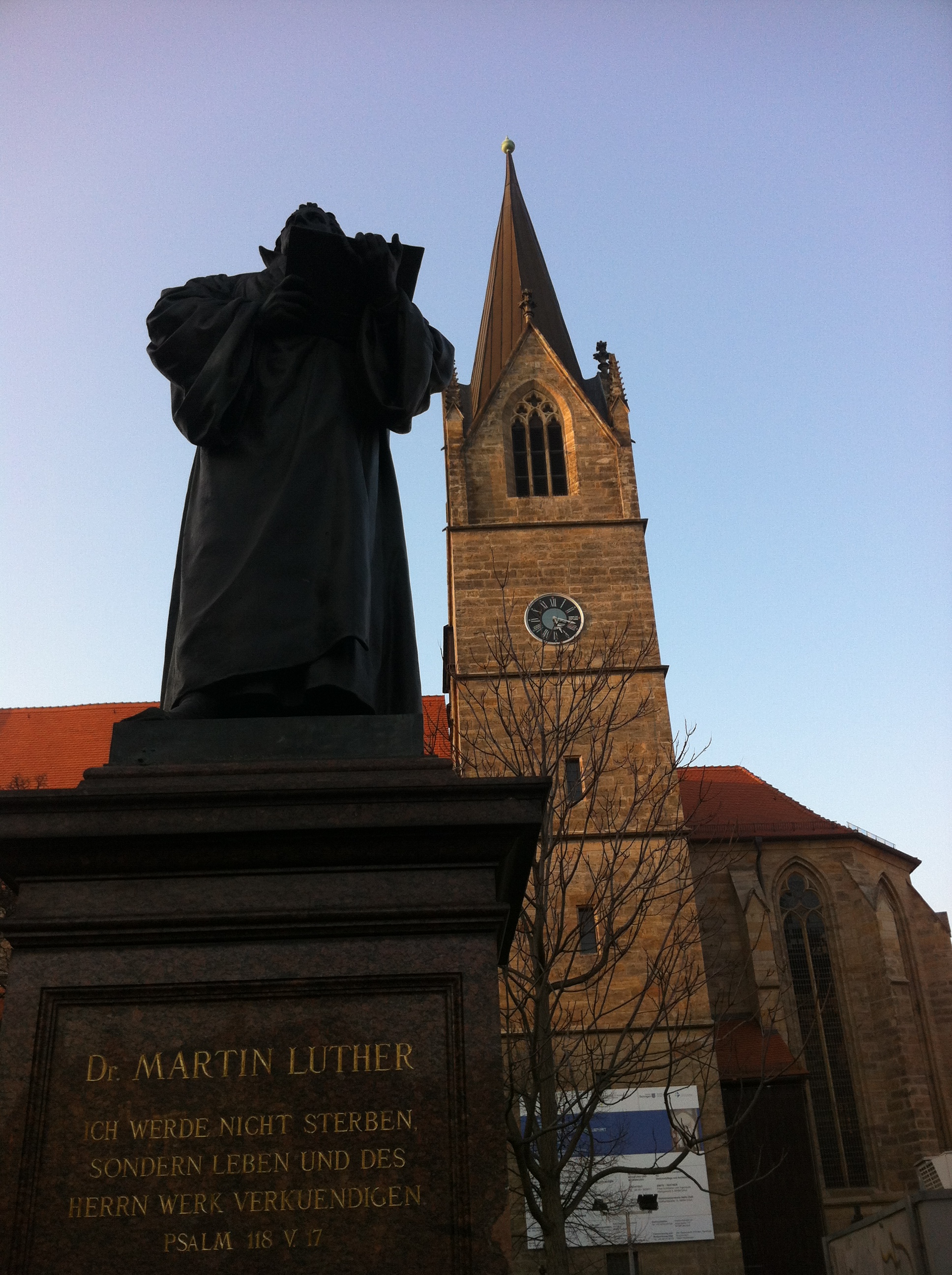
Erfurt Luther statue

Deconsecrating but not Disappearing

(a homily for the deconsecrating of the Finnish church home in Montreal)

stone fence removed one 

Do you remember the famous leaning wall of Simpson? We never called it that. But that’s what it was. The Finnish leaning wall. The stone wall that, over the years and over the decades, decided it didn’t want to stay in one place anymore. That wall started moving even before we did.

I remember one day meeting Frank Berninger, Kati’s husband, standing by the wall with cement, trying to fill in some of the cracks that had developed as it ever-so-gently tipped out over the sidewalk. Or more often, poor Ismo, out there how many times a year?, measuring the angle of the stones, how much every winter freeze up and spring thaw would nudge the stones just a few more centimeters out of place. All those church council meetings where we sat thinking, and worse, imagining, not daring to say it out loud to each other: what will happen if someday that whole humpty-dumpty arrangement comes tumbling down and there’s a car, or God forbid, a person walking by when all those stones let go and gravity takes over completely?

How can we forget? All that beautiful field rock. And now? In the words of Jesus about a different Temple, not one stone is left upon another. The wall – that long, beautiful wall that looked so permanent – is gone. As is the garden. As is the day when young Finns would sit and pose by the fifties and the hundreds for black and white photos like we have hanging in the dining room. All gone.

But WE are still here. By your endurance, Jesus said to his disciples, you will continue. Life, hope, growth, vitality. They are not so easily measured, nor given up.

We human beings are easily fooled. We think that bricks and stone, mortar and wood will outlast us. That might be true, in terms of us as individuals. But in terms of us as the children of God, as the family of the Almighty, and as the realm of the Creator in this age, that kind of thinking is dead wrong. Brick and stones will NOT outlast us.

The God of the Bible is big on promises – big on vision. And it’s almost a constant, that the most certain time for a promise is precisely the moment when things seem at their darkest, when it feels like the whole world, and not just a wall, is tipping.

If ever a congregation was facing tough days, it would seem to be our little community of Finns. Here we are, wondering how it will be for us to move in with the Estonians. Here we are, dividing up books and looking at odds and ends, and recycling and taking home bits and pieces of this and that and the other. We’re like survivors of a shipwreck. This building that is so loved it is called not just a church, but a church HOME for so many years, will change. Its façade will stay. But when the massive front end loader shovels dig in behind, it won’t be pretty.

So what a day to receive such words of promise!

The Lord shall watch over your going out and your coming in, says the Psalm we have heard in the greeting and in the liturgy. Not only now – but from this time forth, and forevermore. This is a vision for AFTER the stones come tumbling down. When not one is left atop another. This is a vision of care and concern and support. It’s a FUTURE. We should make no mistake. It is a promise. Not as the world judges it, but in the eyes of the one who knows us better than the world. I will pour my spirit out, says God through the prophet Joel, so that your sons and your daughters shall prophesy, your old folks shall dream dreams, and your young people shall see visions.

If we are people of faith then we are always in some kind of crisis, because crisis is where God takes us in order to move us forward. In the midst of THIS crisis, this closing of the Finnish church home, it’s especially important to hear this call: in what ways, right now, are WE supposed to dream dreams and see visions?

In the “great and terrible” day of the LORD, things are reduced to their essentials: what is the ministry of this community? What can we do to reach out, not just to the church, but in God’s world, which is so much bigger and more exciting a place? How can being reduced to nothing (to speak like Paul in 1 Corinthians) …how can being reduced wind up being a beginning point of great opportunity for you and for me and for the Finnish community?

The days are surely coming, and are here, not just for this little congregation, but for all of us who call ourselves Christian, when you and I will be called on to do something NEW. We have no choice. The church is changing all over Europe and North America. There will be no walls to protect us. No false securities. The old has passed away. The new has begun. The Lord is your keeper. The Lord is your shade at your right hand, so that the sun shall not strike you by day nor the moon by night.

SO: let us remember that God is the greatest dreamer of all.

The leaning wall of Simpson wasn’t just the leaning wall. It was the leaving wall. What seemed so solid has detached and is gone. It led the way and now it is our turn as a community, also to leave, and to go forward into a future where we do not know our paths, but only the one who walks those paths with us.

The Lord shall watch over your going out and your coming in, from this time forth and forevermore. In these coming weeks, and in this coming year, which will surely be unsettled, may we see where our TRUE foundation lies. May we see the liberation that comes with losing something so that we might gain something else. May we recognize our Lord in the wilderness. May THAT be what inspires us, and the point of view that gives us direction. Our heads are raised. May God grant us a vision, and through this present passing, bring new life to us all.