Our problem is simple, and it’s this: on the one side we have a God who, we say, is almighty, all powerful, all-knowing and all-loving. On the other side, this God’s world has toddlers lying drowned on beaches and terrified young girls kidnapped out of their schools by armed men who sell them as slave-brides. How do we reconcile our beliefs with the suffering of the innocent? It’s the age-old dilemma of faith.
This world, I realize, also has rainbows and beautiful sunsets, laughter and hugs –
but not enough of those, not nearly enough.
Today is a dark day, a way-of-the-cross day.
Today is a day to hear the crowds shout for blood, and to see Jesus’ blood streaming down his face from the thorns.
Today is a day for remembering sadism, the callous ability to cause harm, the sickness of powerful men who find joy in hurting others. Let’s be honest and name evil for what it is, and how OFTEN it is: today is a day for marking that there are, in our world, too many sociopaths and psychopaths, and not just individuals, but psychopathic tyrannical governments, too, whole systems that murder to cover up, who would rather their citizens die than vote, or who believe peace means crucifying to make an example. Demonic powers, the power of the dollar that sells arms to countries where children soldiers shoot other children, the powers of efficiency that ran the trains to the gas chambers, the powers of cynicism that say there’s nothing we can do, except to make our own selves comfortable and make money. How can we believe in a God through all this?
Crucify him! Crucify him! There is NO answer to the problem of innocent suffering. These children do not deserve to suffer. That’s the truth. All we can do, this frightening not-so-Good Friday, is to say that loudly and clearly. There is no faithful answer to suffering except one – the voluntary suffering WITH others. The standing up to injustice, even when it costs us, as well. And the remembering that God was in Christ, as Paul says, on the cross – the holy, terrible, awful, painful, wrongness of the cross – reconciling the world. For there is no answer to innocent suffering, except to stand with the innocent.
I don’t know if you saw this in the news, but this last week the House of Commons, in Ottawa, elected a man who shouldn’t have been there as a speaker for the day. Mauril Belanger, who has been an MP for 21 years, has no voice anymore, because of his advanced Lou Gehrig’s disease. His long-time dream was to become the Speaker of the House. That will never happen, because of his ALS.
But the Parliament voted to have a one-day, honorary Speaker role, and Belanger is the first person to have a chance to fill it. It took some creativity, some changing and bending of the rules. Was it the right thing to do? Absolutely. It made all the difference to this one person, and, I would argue, to the humanity of the whole House of Commons.
Mary, always the impulsive one, took a whole pound of a costly perfumed lotion, and then, in full view of all the dinner guests, she came around the table and began massaging Jesus’ feet with her perfume and then wiping them down with her hair. Caressing the Teacher. In full view. It’s scandalous. We hardly realize, now, how scandalous. Imagine the incredibly bold sensuality of having a woman, in that society, perfume your feet and use her own hair to dry them.
And yet, somehow, according to Jesus, of all the things that were being done at that particular dinner by all the people who were there, it was the only thing worth remembering.
So what was it, exactly, that Jesus liked so much? So that we can behave more like Mary? I wonder if the principle isn’t that, when in doubt, we should follow our hearts, and follow compassion, and not always think and act logically.
On the level of calculations of benefits, the perfume was wasted on Jesus. But that’s not the whole TRUTH, if you see what I mean. Because Mary, by doing the wrong thing in the eyes of the world, did the right thing. And as the heart usually does, it finds a wisdom more wise than the world. In the logic of the Kingdom, Mary behaved like a saint.
We preach Christ crucified, said Paul, A stumbling block to Jews and idiocy to the rest of the world. And yet we still preach, confess, baptize, commune, and believe. We raise a cup of wine and a loaf of bread and say: “This is my body, this is my blood, given for you”. We spend a few hours a week neither exercising our bodies nor making money, but doing the strangest thing of all: gathering together to worship and care about each other. We are, in the eyes of most of the world, wasting our time.
What are you and I going to do next? We have that expensive pound of perfume in our hands. It’s either efficiency or love. May God help us, when we are faced with the rules of what is “appropriate”, to see the holy wisdom in following Mary, and doing, not what makes sense, not just what the rules might tell us, but what’s right.
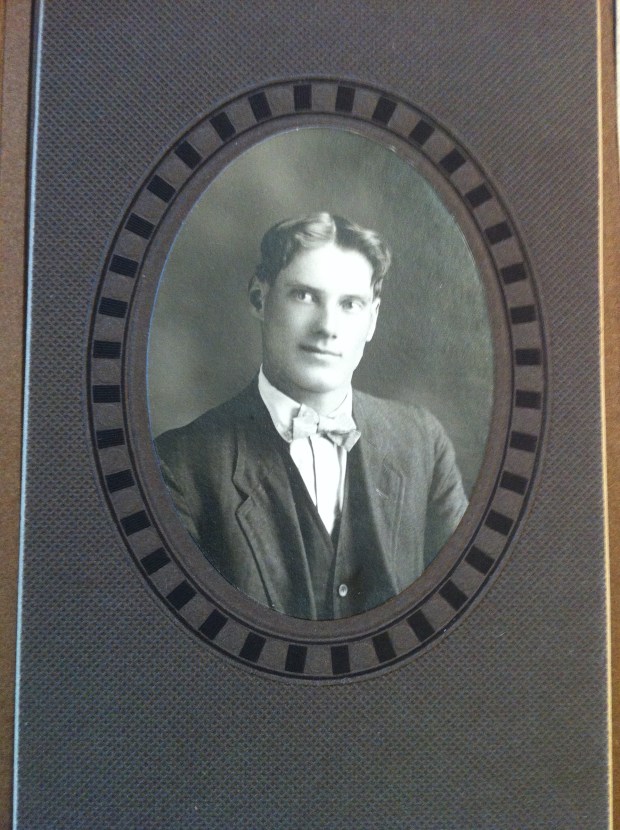
My grandfather – my mother’s father – was a character. As a young man he’d been a handsome fellow who worked on the railroad all across the northern United States. By the time I remember him, he was a tough and crazy old man. He lived out on my uncle’s farm. Or that’s where he sat, in a chair, in the corner of the farmhouse, and preached. As far as I could tell, he didn’t do much on the farm except some cooking. But he liked to express his opinion. All day long. And he had LOTS of opinions.
It’s the big money people, he’d always say, shaking a bony finger at me. I found this thin, bony old man with the piercing blue eyes more than a little scary. Don’t you ever forget that. When I picture Old Testament prophets, I see him, because that’s what he looked like. All emaciated, bone and ropy sinew, chin stubbly and startling, bright blue eyes wild: It’s the BIG MONEY PEOPLE, he’d rail. Damn them! We’re the little people. We’re just pawns. They’re the ones running this world. They don’t care about you and me. Only the almighty pocketbook!
Some men came to Jesus and told him to be careful about what he was saying. Get away from here, they told him, Herod wants to kill you. Kill the man, kill the message. Jesus was saying uncomfortable things. He was, as they say, speaking truth to power, which gets you crucified. Traditionally when scholars talk about this passage, they call it “Jesus’ lament over Jerusalem”. But the essence isn’t really Jerusalem. It’s my grandpa. It’s a bit of a rant about power.
Oh Jerusalem, says Jesus. You can almost see him shaking his finger, like my grandpa. Oh Jerusalem:YOU BIG MONEY PEOPLE. See, your house is left to you. In other words – the crash is coming. And I tell you, you will not see me again until the time when you say: ‘Blessed is the One who comes in the name of the Lord’.
In Jesus, we see something else about prophecy. Real, honest, reproof is there, not to deflate us, but to take care of us. To nurture us and heal us and make us healthier and more whole. Like a hen who keeps her errant chicks warm and safe.
I don’t know if you noticed this, but did you see who it was who tried to warn Jesus? None other than those same people who are traditionally painted as his enemies: the Pharisees. THEY were the ones who came to Jesus to say: “Get away from here – Herod wants to kill you.”
I used to think my grandfather was crazy. Maybe he was, a little. I used to think his words about how it was the big-money people manipulating everything were incredibly naïve. I grew up to scorn him, a bit. To think he was a conspiracy thinker and a bit loony.
Then came the Gulf War. All those Iraqis dying, and some mostly poor, mostly black, American kids. For the sake of what? Oil. Somebody’s profits. Then came Hurricane Katrina at New Orleans. And the levies, which government report after government report had said to fix, but never were because they were in poor neighbourhoods, were washed away, and the lives of so many poor African-Americans with them. Then came the Exxon Valdez oil spill, and the Deepwater Horizon oil spill, and people got sick but nobody paid. Then came the financial crisis, and who gets bailed out together with their huge severance packages? The poor people who lost their homes? No: the bankers.
Maybe my grandfather wasn’t so crazy after all.
Jesus was a thorn in the side of the rich, powerful, political elite of his day, centred in Jerusalem. Don’t buy into their schemes, he told his disciples and anyone who would hear him. Love is free. The world is yours, not theirs. Is it any wonder he wound up the way he did?
To be a person of faith is to believe our Creator can and does still, somehow, speak to us. If we hear words that pick at us a bit, that is not necessarily a bad thing. Not everything my grandfather said was worth listening to. But he was right about this: there are powers in this world that ARE evil, because they side with death and don’t care about life. In that struggle, we need to be on the side of those who celebrate, share, and preserve LOVE. Jesus said so, with his life. In this one thing, at least, grandpa was right.
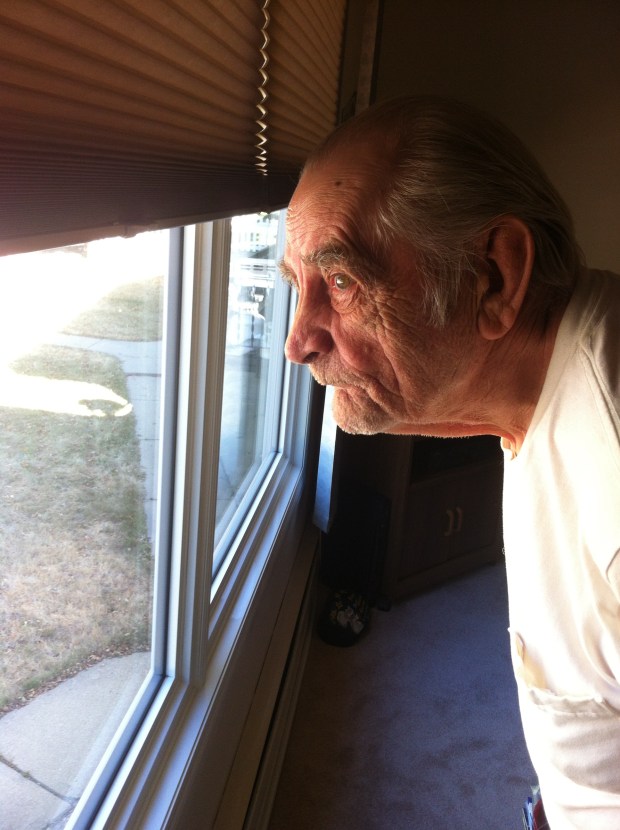
photo by Matthew R. Anderson
(this last photo is not actually my grandfather but still a relative, who reminds me of him sometimes)
Today, with how cold it was, I got out the gear. Actually it was kind of fun. Snow pants, long special mitts good to -40 Celsius, thermal underwear, Russian-style hat, boots. Since this winter has been, generally, so mild, it’s okay – maybe even good – when every now and then the temperature drops. Nobody is complaining about the cold snap. So long as you’re prepared, you’re okay. Right?
Jesus, apparently didn’t have much preparation time for his excursion in extreme conditions. Luke says that Jesus returned from the Jordan river area and was led into the wilderness. Just like that. No prep time.
That word – wilderness, and the mental and physical and spiritual space it represents – is important. We Canadians have our own form of wilderness. We call it winter. We’re proud of it and scared of it, at the same time. Like the people of the middle east, or peoples anywhere, and their wild places. In the Bible the wilderness represents more or less what the hardest times of winter represent for us Canadians – a place of deprivation, but also of challenge, and survival. Also, and very importantly, the wilderness represents a place where Israel, and later Jesus, and later, the early Christians, consistently meet God. In that struggle for survival and meaning they define their true identity.
Interesting, how that works. It’s the HARD places, the difficult circumstances, where we tend to find our true characters under stress, AND where our Creator is to be found. The wilderness is a place that allows us, in fact, drives us, to meet our Maker. It’s just us and the elements, the most basic needs to survive. Lent represents our time in the cold. Our winter.
On the morning of Ash Wednesday several years ago, a devout Christian friend of mine went to see his spiritual adviser. This person happened to be an elderly neighbour. My friend had known her for years. He trusted her completely; she’d guided him through some difficult times in his life. He’d gone to see her that morning for advice on how best to mark Lent, the traditional Christian season of preparation.
When you get home after the Ash Wednesday service, she told him, I have a very specific task for you. Yes, yes, he replied eagerly. You cannot and must not falter in it, she went on, seriously. What could the discipline she was thinking of possibly be, he wondered? Perhaps she was going to ask him to fast. My friend has given up chocolate for Lent almost every year since he was sixteen, and most years he gives up alcohol. Depending on the year, he’s set himself various other disciplines as well, such as praying before sunrise, not watching any TV, not eating Fridays, or abstaining from tea or coffee. Just about everything. Yes, he said to his mentor, almost impatiently. What is it I should do for my spiritual edification?
I want you to go home, she told him.
Yes!
Straight home, mind you. She shook her finger at him.
Yes.
Promise?
Promise.
And go to your kitchen…
Yes!
Then pour yourself a nice big glass of wine and RELAX!
What?My friend was in shock. Why would his mentor say that?
There are two parts to what Jesus relates in Matthew. The first is about how we’re supposed to do what we do. When you fast, says Jesus (notice: when, not if), don’t let anyone know it. Surprise even yourself if that’s possible. Just do it. Naturally. And when you give money or time to a good cause, do that also, yes. But be so careless about the whole thing that your right hand won’t let your left hand know what you’re doing. Do not store up for yourselves treasures on earth. Instead, store up for yourselves treasures in heaven. For where your treasure is, there your heart will be also.
Jesus isn’t talking about piety. He isn’t talking about good works. And he ISN’T talking about Lenten disciplines. Jesus is talking about attachments. (By the way Jesus almost sounds Buddhist). For most of us, our problem is not giving up riches, which we don’t have tons of anyway. Sure we could use texts like this to poke fun at Donald Trump. But he’s not our problem. At least, not yet.
We’re not attached to great fortunes, most of us. But we have unhealthy, problematic attachments just the same. My friend was wrongly, dangerously, unspiritually attached to some otherwise very good disciplines. It seems odd, but it’s true. Even monks can argue over who stays on their knees praying the longest. Where your treasure is, there your heart will be also. Even if that treasure is the respect of other pious people, or our place in the pecking order of those serious people who really give up something, or our feeling of happiness over being good, or the small glory of being seen to be smart or organized or useful or especially, in our world, BUSY.
Pour yourself a big glass of wine – and relax! It might not be for everyone. But in my friend’s case, the advice was dead on. Avoid any attachment, this neighbour was saying, except the only attachment necessary. For I have given up all things, says Paul, and I consider them all rubbish, except one: the surpassing glory of knowing my Lord Jesus, and being found in him.
There. Christians should be attached to THAT. Being found in Jesus, even if drinking wine during Lent, is a true Lenten discipline, indeed.
This last summer on my pilgrimage across Saskatchewan, we walked an average of about 20 kilometres a day. The journey took place the end of July and the beginning of August. The days were boiling hot, 10 hours a day under a beating sun. The nights could actually get quite cool, in the hills down to four or five degrees. You had to be ready for anything. We faced heatstroke, cold, lightning, constant wind, limited water supplies, poorly-marked trails, and sore feet. So the last week when a senior citizen named Harold asked if he could join in, I was a bit skeptical.
It wasn’t so much that Harold didn’t look fit. He just looked OLD. I couldn’t tell how old, exactly. But old.
Are you sure this is going to be okay? I asked my friend Hugh. Hugh was walking the whole trail with me. Hugh was in top shape, had done most of the planning and had a good sense of what we were facing, better than I did. Don’t forget, I thought: any group is only as fast as its slowest walker.
It should be okay, Hugh responded. I’ve known Harold a long time. He might surprise you.
The first day Harold showed up, he came with an ancient orange back pack, the kind I had back in the 1970s. Oh no, I thought. Here we go. And he was slow – a bit. He lagged behind, a tad. But he never once complained. And when the rest of us stopped for a break, Harold kept going, so that he never actually slowed anyone down that first day.
The second day, Harold’s backpack looked different. What did you do to it, I asked him? I’m carrying more weight today, he said. And I’ll carry more tomorrow. My intent is to build up the weight until I can carry everything I need on my own back.
Now. None of us were doing that. We were ALL getting our tents and supplies ferried from one spot to another, just carrying our needs for the day. But Harold was determined to carry everything. And he did. Over the next five days he kept adding stuff to his pack until he was carrying his tent, his food, and all his gear.
And he got faster. By the end of the third day, I noticed that Harold was fairly consistently ahead of me. On the fourth day, we came to a set of hills. Where the rest of us took the lower route around, Harold looked up. “I’m a hydrologist,” he said. “As a scientist I’m really interested in rock formations. I’ll just go up these hills to have a look and meet you at camp.” And he did. We went around, he walked UP. And up. I could see him striding off into the distance.
On the fifth day, I was up early. Unlike the rest of us who had real tents, Harold slept in a sort of plastic sheet. As I watched, he came out it, and stretched, then sat on the ground and made himself tea. He didn’t seem to be half as sore, or as krinked up from sleeping, as I was, and the ground in that spot was NOT warm. He and I had become friends over the walk, so I walked over to where he was, and asked a question I’d been wondering for some time: “if you don’t mind my asking Harold, exactly how old ARE you?”
This man who had transformed, in those few days, into a master backpacker looked back at me and smiled. “How old do you think I am?”
Jesus, it says, was CHANGED in a wild and crazy X-files moment when Moses and Elijah suddenly appeared and the lights of heaven all came on. Transfiguration means changing. But instead of Jesus changing, maybe what really happened that day, what really changed, were the eyes of the disciples.
It’s like Harold. In the space of a few short days, a quiet, struggling elderly man had changed before my eyes. But my question is: did he change? Or was it really me?
In the Sustainability and Diversity class I teach at Concordia one of our readings is by a scientist by the name of Marten Scheffer. Scheffer describes a mechanism of perception that is almost universal in nature. It has a technical name, but we can call it “locking in perceptions”. It’s a way of quickly assessing sensory inputs. What happens – whether you’re a human being or a frog, apparently – is that if you see something that LOOKS like something you’re familiar with, your brain jumps to “lock in” that image or perception quickly, so you can react. We see what looks like a bear and our adrenaline kicks in, before we necessarily get all the information to fill in our initial sensory impressions.
That’s a good mechanism for survival. But not necessarily for judgment.
Often we just don’t see others for who they are. Most of the time, we don’t even see OURSELVES for who we are. When we do, it’s so shocking and so rare we call those moments “revelations”.
Does anyone see in you evidence of the little girl you once were in the old country? The little boy who used to shine his father’s shoes? Is there anyone in this world who can look at you and see the time you travelled, or the books that changed your life, or the time you won the swim meet, or that evening you skated in a magic winter landscape when the trees were frosted, or the key shaking in your hand when you bought your first house, or when you went through that terrible winter, or you shared that wonderful love, or whatever it was that has happened to you to make you the person you are? It’s not a mistake that that’s one of the lines of “Amazing Grace” is exactly that. “I once was blind, but now I see”. Enlightenment means starting to see each other and our world, in an Amazingly Graceful way. Seeing this way means seeing not necessarily the way things are but the way things REALLY are. Behind and through failure, and brokenness, and death, and suffering, and decay. Seeing the life that God is calling up, that we can’t even guess at. Theparts of us still hidden in the cross.
So how old do you think Harold is?
I’m 79, he said to me, slowly. I was a rock climber, for years. I was a field scientist for decades. And now, he said, as he shouldered that heavy backpack, and started off ahead of me: I guess I’m a pilgrim, too.
Our Creator promises to see us the way we really are. NOT with the limits and prejudices and preconceptions we normally exercise. How wonderful is that. And what a great and graceful Transfiguration.
“Funeral held yesterday for La Loche shooting victim” CBC News.
“Over 40 dead after migrant boat sinks off Turkey” Huffington Post.
“Increasing concerns over Zika virus is changing tourism patterns in Central and South America” CBC Online.
“Thousands of complaints about the behaviour of physicians lead to very few cases of discipline” CBC News.
If I speak in the tongues of mortals and of angels, but do not have love, I am a noisy gong or a clanging cymbal.
“Nova Scotia winter storm leaves thousands without power this weekend” The Gazette.
“Scientists find genetic link to Alzheimers.” The Daily Telegraph.
“Genetic law urgently needed to keep insurance and other companies from discriminating against those with previously hidden flaws, says watchdog” Yahoo Canada News.
And if I have prophetic powers, and understand all mysteries and all knowledge, and if I have all faith, so as to remove mountains, but do not have love, I am nothing.
“Republican candidate Donald Trump says he’s looking forward to Iowa debate.” PBS Public Radio.
“Man in Oshawa Ontario legally changes his name to ‘None of the Above’ so that voters can choose ‘none of the above’ in the Ontario provincial byelection soon to be held there.” CBC News.
If I give away all my possessions, and if I hand over my very body so that I may boast, but do not have love, I gain nothing.
“Love is patient, love is kind…” We really know those words. They’re some of the most famous from the Bible. Thanks to weddings, even people who never go inside a church know these words: “Love bears all things, hopes all things…” However, they don’t much sound like words from the news. “Love is not envious, or jealous or boastful…”
Love, love, love, love, love. Saying it is all very pretty, but when you get right down to it, what does love mean? This is a bit of a problem when it comes to actually applying what Paul has so beautifully expressed.
He wrote: “Earnestly desire the higher gifts”. And we should answer: of course! The problem is, love isn’t something any of us actuallydisagreeswith. I mean, EVERYBODY thinks love is good. If we hired a survey company to phone a thousand people and ask them about this, 990 would all say the same thing – that yes, love is a very, VERY good thing.
And Jesus too said it: Love one another as I have loved you.
But do we or can we even agree on what this ‘good thing’ actually looks like? How we live it out? Practice it?
There are least two quite different ideas about love. We’ve probably agreed with both at one time or another.
Number one assumption about love is this: we tend to love – and SHOULD love – what we’re used to. As in, only someone like me who grew up in Saskatchewan loves that desolate prairie landscape. Or more seriously: if you were a child who was abused or beaten by your dad, how could you ever come to love a god who sometimes goes by the name “our Father”?
This is what we could call the “natural” ideal of love. We love as we’re able. Love is one of our self-expressions, and as such it is limited by our experiences.
So far so good.
However, there’s ANOTHER idea about love, and it can’t be stressed enough that this second idea about love isn’t the same. In this idea, love doesn’t necessarily come OUT of who we are and what we experience. Rather love goes INTO who we are and what we experience. In other words, if we love in ways that don’t necessarily come naturally, perhaps what is natural for us will change.
Consider again Paul. The guy who wrote: Love is patient and kind.
Paul? Anybody who’s studied the man knows that patient and kind are not the first words you’d ever use about Paul. It doesn’t sound much like the sarcastic apostle who told his opponents in the book of Galatians that if they wanted circumcision so badly they should just go all the way and castrate themselves. Frankly, he could be quite nasty at times. It sounds to me a bit like Paul was hoping someday he might live up to his own words.
But would that be so bad? Maybe, instead of love being what comes naturally, sometimes love has to be what is actually a stretch. Most of us can be, and often are, basically kind people. But it’s harder to be loving and caring about some Christian we don’t know, who speaks a different language and has a different culture, who is a refugee from Syria. Or, even more, the Muslim refugee from Syria. That’s the kind of love that takes, not just a natural rush of sympathy, but several days or weeks or months’ worth of conscious caring.
Sometimes we get the idea that the opposite of love is hate. We’re wrong. The opposite of love isn’t hate – it’s caution. It’s half-heartedness, fear, and distance.
Maybe, if we think biblically, we’re cautious of the kind of love Paul describes because we realize, down deep, that to love that way might be the end of us. Literally. Like it was the end of Jesus.
Since we ALL say we believe in love, we’d better know what it is we’re agreeing to. Paul leaves no doubt. Real love, he says, follows Jesus, who was not scared to show it. Real love results in the destruction of the old self and in the creation of a new self.
Love, in other words, is scary.
And that, as it turns out, is exactly how God loves us. Despite our faults, despite our failings, despite years and years of minor or major betrayals, there is a hidden subject behind this passage. Our Creator still bears all things, hopes all things, believes all things, and endures all things about us.
You and I are called to learn to love as does our Lord. Not as we can. But beyond what we can.
And these three remain: faith, hope, and love. But the greatest of these is love.
In the calendar of the western church, today is the feast-day of the Conversion of St. Paul. This is a bit of a problem. Especially, it’s problematic for any Christians who happen to be biblical scholars. It should be a problem for everyone who still marks this day. It’s pretty much accepted, now, at least in academic circles, that Paul didn’t convert. That is, on the road to Damascus, whatever happened to the extremist Saul of Tarsus (between horses in the paintings, no horses, voices from heaven, no voices, scales on his eyes and assorted other details one can take Acts to task for, since Acts repeats the story several times with variations) Paul didn’t stop being a Jew and suddenly become a Christian. Perhaps the easiest objection is that he couldn’t have! There was no such thing as Christianity for Paul to be converted to.
But there are other, more substantial issues. For one thing, in his own writings Paul never says he converted. Rather, he presents himself very much like an Old Testament prophet, called by the God of Israel (not some new deity but the one Paul knew all along), to proclaim that God’s Messiah, Jesus. The fact that so many Jews in Paul’s own day didn’t think Jesus was the Messiah is, in this case, beside the point. All of them were thinking of Israel’s God, no matter their disagreement on whether that God was, or wasn’t, responsible for the crucified teacher from the Galilee. Paul was a Jew, a Jew who believed with every molecule in his body that the Messiah had come, and that Israel’s God was about to change all of human history. In what he believed was the world’s defining moment, he thought his particular task, as a faithful Jew, was to invite the non-Jews into the family of Israel as they were, as non-Jews.
So Paul was not a Christian. This, by the way, is the title of Pamela Eisenbaum’s book on the subject. Perhaps there will someday also be a book with a title something like “Paul is not a (contemporary) Jew”. Judaism, like Christianity, has changed since the first century. Both contemporary Judaism and contemporary Christianity are children of a heterodox first century faith that no longer exists.
Paul once wrote: “I have become all things to all people”. Well, he got what he wanted. Paul has been made and remade so many times in our images it’s hard to know what he ever really was. The poor apostle’s been co-opted by supercessionists, by gnostics, by anti-semites, conservatives, liberals, sceptics and humanists alike. He’s been promoted as everything from the first liberated male of western religion to the one person responsible for everything bad about Christianity. The truth, as always, is probably not just in between, but lost, lost somewhere way back there, in the first century. However, there’s one thing we can be fairly certain of on this Feast-Day: whatever else he did, Paul did not convert.
This last week a friend of mine, Orit Shimoni (http://www.oritshimoni.com/), came to town to perform. She’s also sometimes known as Little Birdie. Years ago she did graduate studies at Concordia, which is where I met her. Now, she tours all over the world playing her music. The place she sang at last Wednesday was a café on Cote-St-Luc road (not very far from here). It’s a small venue – fits maybe thirty people. She did the set with just a guitar and nothing else, so the words were really clear. Orit’s got kind of a theological bent to her music, which is one of the reasons I like it. One set of lyrics in particular struck me. It was about Cana, sort of.
Apparently, in Cana, in Galilee (that is, in the north of Israel), Jesus and his disciples were attending a local wedding. During the reception, more by chance than anything, Jesus performed his first miracle. He turned water into wine. But for her song Orit turned the words around. “If I could turn wine into water,” she sang, “you would not be alone.” Wine into water? What did she mean? “If I could turn wine into water,” she sang again, “a path to you I’d find.”
Oh, I thought. Oh.
There’s a tragedy behind that song. I didn’t ask her, but I think it’s about alcoholism. Orit sings a lot of sad songs, and songs with bite. But this one in particular has a ring. IF I could turn wine into water. Meaning: I can’t. And even though I don’t know the details, and I don’t know if it’s even about Orit: whoever that song is about couldn’t make a miracle. That’s what the song is about. That person couldn’t stop the alcoholism. Couldn’t turn wine into water. And so now, instead of singing about a happy future, the song is about regret.
Makes for a great song. But a sad memory.
In the Bible story, the bride and groom, in fact, the whole wedding party, are headed for a disaster. Not an earthquake, ice-storm, tsanami kind of disaster. But the small kind of disaster we all run into every day and all hate: a major glitch. A screw-up: the wedding reception was about to run out of wine.
Now. This is not the worst thing that could ever happen. But if you’re the bride and groom, or the person responsible for the reception, it’s bad enough. No wine means unhappy guests. Probably guests leaving. So it says that Jesus’ mother stands up from where she’s seated, and makes her way over to see him.
The writer makes it clear that Jesus and his disciples were at the wedding in Cana, NOT to face any tests, but just to enjoy themselves. It’s not even clear if Jesus knew the wedding couple. I imagine in the hills of Galilee, it might have been a bit like some Italian weddings I’ve been to, where the whole neighbourhood is invited.
In any case, when we meet him Jesus is off in a corner, well-hidden. He’s out of the spotlight and wanting to keep it that way. But then the wedding runs out of wine.
Mary’s clearly a mother who knows her own kid better than he seems to know himself. She comes to his table and announces: “they have no more wine.” As if the next step is obvious. “They have no more wine – now, do you want to leave your own mother without a glass of Chardonnay?” Quite naturally, Jesus responds: “what does that have to do with me?” I love that. This is NOT the pious, angel-faced, head-upturned or downturned Virgin Mary we see in statues so often with her hands clasped meekly at her side. This is a tough Jewish mother who knows what her son is capable of, and won’t take no for an answer.
You would think that the Lord speaking should be enough for any human being. But no. Mary ignores Jesus completely. The Son of God, the Lord of Life, and what does she do? She goes back to her own table. And tells the servants: “do whatever he tells you.” She KNOWS he’s going to fall in line! The fact that the Bible treats a lack of wine as a disaster is already interesting. But that’s NOT the main point. The main point, at least in my thinking, has to do with the water.
You can imagine Jesus sighing and shaking his head. Once a kid, always a kid, even Jesus. Do you see those stone jars over there, he tells the servants? Fill them to the brim with water. Then, he says, go, take a jug, and fill it up from those same stone jars, and take it to the chief steward.
And so, timidly, one of them does.
This is where you and I come in. You and I are that one scared servant. Like the woman my friend Orit was singing about, you and I don’t have the power to do miracles. If we could, we would.
All we can do is carry the miracle. Every time we get together, every time we pray, and especially every time we go OUT in Jesus’ name and try to do something for the world, we’re the poor, terrified, uncertain servants. Just like at Cana, it’s all simple stuff – water, bread, wine. Or maybe in our cases, it’s a hug, or a song, or an ear, or a moment’s time, or a few dollars, or a few words. Now draw it out, Jesus tells us, even though it looks like simple water, and take it to the world.
So. If we’re faithful, if we’re trusting, and more often than that, even if we’re doubting, we do that. We draw the water out of our unremarkable, unmiraculous lives. Because ultimately, THAT’S ALL WE HAVE. Then we go. We carry what we fear might be way too ordinary, to a world that doesn’t expect or believe in miracles, but like the wedding guests need them just the same. And if it turns out that the water is just water, then, like St Paul said, we’re the greatest fools of all.
It took faith for whoever that first nameless servant was, to take a jug of what he or she was pretty sure was worthless, and take it to the head steward of the whole feast. And it takes faith for you and I to do OUR simple commissions, with our simple lack of resources and abilities. But we have to. That’s what we’re supposed to do. That is how we will be judged.
And just in case you and I think we have nothing to offer, we should think of the news story from CBC this last week. Did you hear about it, or read about it? There was a fourteen year old kid who was begging on the street, saying he was homeless, and in the midst of that terrible cold of this past week, although a few folks gave some change, guess who was the ONLY person to stop and offer this kid a coat – in fact, the coat off of his own back? The only person to help was another street person, an Inuk man, Putulik Kumaq, originally from Nunavut, but homeless on Montreal streets for the past 17 years. It turned out that the 14 year old kid was doing a school project and was being filmed secretly by his brother, which is the only reason we know about this selfless act.
Anytime we say we have nothing to give, we can remember the servants, who were just asked to carry water, and we can remember Putulik, who said “it’s cold, and I had a feeling he needed help”.
On the third day, it says, there was a wedding in Cana in Galilee, and here, amid the food, and drink, the visiting and gossiping and the stuff of life, Jesus did the first of his signs.
Wine from water is just the beginning. That is the real point. In your life and mine, wine from water is nothing, compared to what our Creator can do. You are carrying miracles, if only you know it, says the Creator of singers who come to Montreal, of street people and poets, of Putulik and Paul, and of you and me.
I went to visit a parishioner in the hospital once and was completely thrown by what I discovered when I walked into her room.
Maybe I hadn’t been paying enough attention. Someone had told me what this woman was in for, I remember that. But I’m afraid it had gone straight in one ear and out the other. So when I walked into the hospital room, I was surprised to discover there was no bed. Instead there was this thing in the centre of a large space. It looked like some kind of miniature circus ride. Or a space-ship pod, or a climbing frame or something.
Hello? I said, tentatively. I stopped in the doorway. Was I in the right place? Then from the middle of the tubing and bars I heard the small voice of my parishioner: “hello….I’m down here.” I peered closer. Near the floor. And there she was, strapped right into the middle of that contraption. Hanging upside down.
I walked up to it. There was a bed there, all right. I could see it at this point. But it was an upside down bed. There was also a chair beside it. When I sat in the chair I couldn’t see the woman at all. It’s called a Stryker frame, she informed me dryly, while I sat down, got up again, and then kind of wandered in a circle around her, looking for some way I could actually make eye contact. Are you having trouble, pastor?
Obviously, it should have been me asking HER this question. But there we were. I have a spinal cord injury, she told me, while I dithered and fidgeted. I’m going to be in this thing a month, at least. My poor husband’s stuck at home working his job and taking care of three kids. We’ll be lucky if we’re still together by the time I’m out of this thing. You can stop shuffling around like that. She sounded annoyed. I’m not going anywhere.
I stopped shuffling around.
Are you okay? She asked.
I’m okay, I answered her.
Well, I’m not, she said. Welcome to my own personal hell.
Now when all the people were baptized, it says, and when Jesus likewise had been baptized and was praying, the heaven was opened, and the Holy Spirit descended upon Jesus like a dove. And a voice came from heaven: “you are my son, the beloved, with you I am well pleased.”
So pleased, apparently, that God would lead this Beloved Jesus, also, to his own personal hell, tortured and dying, on a cross. Someone once said: beware of being one of God’s favourites. It gets you into trouble every time.
And when you think about it, isn’t that true? Martin Luther would’ve been burned at the stake if they could’ve gotten hold of him. Or Martin Luther King, shattered with a bullet for speaking up for justice. Or Thomas a Becket, run through with a sword right there, on the steps of his altar. Or Saint Paul, persecuted and ridiculed and shipwrecked and murdered. Or any of a thousand Syrian Christians right now, in a country that was one of the first blessed with the Gospel, fleeing desperately to save their lives.
With you I am well pleased. That’s what the voice said to Jesus when he was baptized.
It’s an odd sort of pleasure.
In trying to understand the mystery of why Jesus was baptized at all, I think about the woman in the hospital, who told me she was in her own personal hell. Or the comment I saw on Facebook yesterday, congratulating another woman on her first cancer-free diagnosis. After five years of hell, said the Facebook post, finally free!
Yes, I think. I understand hell, when you put it like that. Probably all of us do. Certainly any of us over – I don’t know – 40 years of age. You don’t make it that far without a few cuts and bruises: cancer, divorce, separation, child problems, parent problems, dreams lost, dreams found. Who knows? Life, we eventually realize, isn’t what we do when we’re not suffering. Life eventually becomes, more than we might think, the ways in which we DEAL with suffering. Live through it. Rise, not above it, exactly, but with it. Sometimes, even, because of it.
So maybe the baptism of Jesus makes sense if we think of baptism, not as something that leads away from suffering, but something that leads straight through it. And then, if that’s it, the fact that Jesus was baptized means that he was willing to take on, willingly, the kind of voyage into hell that the woman in the Stryker frame was talking about, or that the Facebook post person was just getting over. The human condition.
I felt like such a fool for the first few minutes I was visiting that woman in the Stryker frame. I just stood there, towering over her while she complained bitterly and then cried about what she was going through. I felt completely out of place, awkward and embarrassed. It took me forever to realize the simplest thing: that I didn’t need to be standing at all. Eventually, when the nurse came in, she found me where – if I’d been sensitive enough to realize it – I could have been from the beginning: on my back, on the floor, parallel to the bed, looking up at this parishioner. Sharing her perspective.
What really pleases God, it turns out, is solidarity. That’s what the baptism of Jesus is probably really about. For Jesus emptied himself, Paul writes, taking on the form of a slave, and in that form – on the floor, lying beside our human suffering, he became obedient, in love, to the human condition, even death on a cross. Only then was he raised. Like Jesus, it will be for us only when, trusting in the compassion and community we see in the cross, and finally beginning to understand this strange way of being God’s favourites, that we too, through death, in solidarity with the one who went first, will know what it means to rise again.




 Unsettled Words