Matthew Anderson

The Stranger who travels with Us

Dovrefjell

I recently heard a story about a Norwegian acquaintance of mine. She was in Germany at a conference, and when one of the German academics first met her, she told her: “oh, you’re from Norway! I’d love to visit Norway someday.”

That’s nice. Right? Norway is a beautiful country. Nothing strange about what this woman said. Presumably, lots of people would love to visit the land of fjords and mountains. But what was a bit jarring was what came next. “My grandfather always told me stories, as I was growing up, about how lovely a country Norway is,” this German academic told my friend. “So I’ve always had this image of your homeland as a very special place. He said that in the early 1940s he spent some of the happiest years of his life in Norway.”

My acquaintance was a bit nonplussed. Did the German not realize what she was saying?

Yes, World War Two is long over. Yes, now Norwegians and Germans are neighbours and, very often, even friends. Yes, there are lots of German tourists welcomed in Norway every year. But did the German not realize that the ‘happiest years of life’ for her grandfather, who almost certainly was in Norway as a soldier during what was a brutal occupation of the country, were not exactly the happiest years of Norwegian history?

Countries, like people, don’t mature and grow up without suffering, and sometimes, without causing suffering. And the church is the same.

Perhaps no institution in the western world has been the cause of so much growth and help, relief and education and hope as the church. Perhaps no institution in the western world has been the cause of so much misery and pain and ignorance and hate and death, as the Christian church. So when we hear the words of the prophet: the voice of one crying out in the wilderness, Prepare the Way, we need to start by being a LOT more sensitive than that German academic. We have to ask ourselves exactly how we, personally, might be implicated in the message. Is Advent good news, or bad news?

For one thing, it means, without apology, that it’s okay to be political. The first words we hear about John the Baptist are political: in the fifteenth year of the reign of Emperor Tiberius, Luke writes, naming the dictator of the day: when Pontius Pilate was governor of Judea, and Herod was ruler of Galilee… You can’t escape it. Advent always comes to us in the midst of politics.

This year, the politics are again brutally obvious: more and more and more shootings, most recently in California, and all the while some Americans saying that there’s nothing to be done. Rivers of blood staining the streets in Syria. Extreme weather events killing people and creating refugees globally – even as world leaders gather in Paris, in a city so recently scarred by the awful terrorist murders of innocent youth, to debate whether the climbing thermostats will make the world uninhabitable for our grandchildren. Millions of people flooding across borders and across oceans. A mass migration of misery. Children dying. Drones dropping bombs. Changing governments, a plummeting dollar, financial insecurity, increasing surveillance, and everyone uneasy.

Prepare the way of the Lord. As if we have time and space and hope enough for that, we think. Make God’s paths straight.

The most basic thing these words tell us is that something IS happening. We can’t put our heads in the sand. Changes are coming – have always been coming – and we can’t pretend otherwise. The world is changing. We are, as individuals, as institutions, and as families, facing massive upheavals. Our bank accounts, our homes, our educations, will NOT be walls high enough to save us. None of us will be the same ten years from this Advent. We can’t escape.

We are heading down some sort of path, into this hard environment, what the Bible calls this desert.

Making paths STRAIGHT seems to be about how we go forward, which is a matter of justice. When it comes to refugees, it’s clear, in recent news, that we can either straighten refugee routes, or we can block them. Between those two options, the Bible is quite clear. Hospitality to the poor and the oppressed is not just expected. It’s demanded. I was naked, and you clothed me, says Jesus, in Matthew, I was a stranger, and you welcomed me. I was on the evening news huddled in the rubble on the newsfeed, and you did something. Whatsoever you have done to the least of these, you have done for me. To prepare the way almost never seems to be about protecting our own interests. Far more, it’s about allowing into our shelters and onto our paths those who need it most. I do not desire your offerings, says the LORD in the Hebrew Bible, but let justice roll down like streams. And yet. And yet we ALSO need to have a good solid sense of ourselves to undertake that prophetic work, otherwise what we do will be insincere and superficial.

And maybe this is the other part of the story. It seems like a paradox, but it’s a basic truth: the more comfortable we are with our own selves and with our own place, the easier it will be for us to travel through the coming desert, to face adversity and to make the paths straight for others. Our basic equipment, so to speak, is how we feel about ourselves, and what we know ourselves to be.

If we FEEL loved, we are better able to love. If we know that we are valuable, it’s easier to value others. If we learn to be gracious and forgiving with ourselves, we will, in most cases, have an easier time being gracious and forgiving with others. So our first task is to remember – and to remind ourselves and others – that WE are valued creations, loved, and accepted, just the way we are. Then we can treat others that way.

We are ALL strangers, and preparing a way means making that highway through the desert big enough for everyone.

There was a lovely video I saw recently about the settling of Saskatchewan. It was so well designed and shot. It talked about how life was hard for the European pioneers, but how life got so much better, and about how prosperous most of those families are now. In one sense, there was nothing wrong with the video at all. It was quite beautiful. But when it was done, I thought the same thing as that Norwegian academic I started out describing, thought of the German: do they not realize? Yes, the pioneers – among them my grandparents – worked hard. Yes, prosperity came. But at what price? The film, meant to be so inclusive, never once mentioned the First Peoples, and the disaster that European settlement was for them.

For us to celebrate an anniversary, or to prepare a way through the wilderness, two things must come together – a commitment to justice AND a sense of our own fractured and imperfect belonging. My friend Kathryn recently posted a quotation from a 4th century ascetic, Amma Syncletica, about how we develop a relationship with our Creator. Amma was a desert woman herself, and she wrote: In the beginning there is struggle and a lot of work for those who come near to God. But after that, there is indescribable joy. It is just like building a fire: At first it’s smoky and your eyes water, but later you get the desired result. Thus we ought to light the divine fire in ourselves with tears and effort.

The desert is not ahead of us. It is where you and I are traveling already. There will be cold nights and hunger and difficulty. As we journey, we can either take note of our fellow travelers, or not. When we do, and when we welcome them, and work for justice, and share love, we are already making the paths straight – for the Creator of all, the One who calls us, is already that stranger who travels with us.

The Pillars of Paris

Grief in Pere Lachaise cemetery      

      Those of us who’ve been fortunate enough to be to Paris are probably all thinking, today, about that place. A lot of us have memories – often very good memories, of being there. It’s such a wonderful city. But it must have been a very dark, a very frightening place, Friday night. I imagine it still is, with lots of fear and anxiety and grief as Parisiens try to recover from something it’s impossible to recover from. I was there just for four days last February, staying near Pere Lachaise cemetery, very close to where the attacks took place.

The bloody murders of so many innocent people give a new meaning to Jesus’ words: Beware that no one leads you astray. …. When you hear of wars and rumours of wars, do not be alarmed; this must take place, but the end is still to come.

The news Friday felt so apocalyptic. It feels like the end of everything we count on being stable in a society, when gunmen enter a nightclub for the sole purpose of murdering innocent youth. Yes, I know we’ve been spared what others go through regularly. I know that such violence is tragically the case in too many places in the world. Beirut for instance. That poor suffering city. But not Paris, or London, or New York. Or Montreal, we hope. I was busy texting my daughter on Friday night: “where are you?” “are you okay?” We cannot imagine the fear. We cannot imagine the loss, for those parents and grandparents whose children did not come home that night, who now, because of hate, will never be able to come home.

For nation will rise against nation, Jesus said, and kingdom against kingdom.

The borders of France are now sealed. The army is in the streets. Presumably, soon there will be even more cameras, more checks, more eavesdropping and surveillance. The French, like the Americans after 9/11 and like us last year with the attack at Parliament Hill and Bill C-51, are going to be even more willing to give up freedom in exchange for the promise of security.

It’s that word – SECURITY – where the warnings of Jesus really hit home. Jesus was standing by Herod’s Temple, and his disciples were going on and on about the stones. Yes. They ARE great stones. I’ve been there. The stones in the Temple foundations are, individually, the size of city buses. Can you imagine if our buildings were built on solid pieces of granite the size of a Montreal city bus? Not just one but thousands of them? We’d think ourselves pretty secure. In Jerusalem the stones are beviled and cut so carefully that you would think they’re put together with mortar, the lines are so perfect. It is a feat of engineering and strength. Something you would think would last thousands of years. But in the end, did even such a miracle of engineering offer security to the people of Jerusalem? Not at all.

Do you see these great stones? asked Jesus. Not one stone will be left here upon another; all will be thrown down.

Jesus’ point is about security. Where it exists and where it doesn’t. No matter how hard we try. For one thing, he’s telling us, security DOESN’T exist in or through the state. The Jerusalem Temple was the closest thing that Jesus and other Jews in his day had to a state institution. It was grand. It was permanent. But Jesus points out – it’s NOT going to save you. And it didn’t. All will be thrown down.

When we put our trust, as we will, in cameras and guns on the street, and surveillance, we will be saying at least in part we DON’T put our trust in community, and discussion and peace-building and mutual concern and education. We will become, perhaps marginally safer, but at a cost to ourselves. And that’s always the way it is with our attempts to safeguard ourselves. They injure us. Ultimately, in this changeable and dangerous world, Jesus is saying that all attempts to be secure and safe result in our putting trust where it doesn’t exist – in other words, all such attempts end in idolatry. FALSE security.

It was actually the Temple, and the City, and the State, that eventually put Jesus to death. Because the authority of the state ultimately rests on violence as well, even if that violence is systemic rather than a bomb strapped to some deluded martyr’s chest.

So. Where do we find security? Only one place: the place where, paradoxically, as Jesus showed us, security seems the MOST absent. The foot of the cross. Paul wrote: I decided to know nothing while I was with you, he except Jesus Christ, and him crucified. In other words, I will live with complete insecurity, for the sake of love.

Where do we find our peace? It’s not that complicated. When we depend entirely on Love, especially the love that created and sustains us, that’s Gospel. When we depend on threat and power, that’s NOT Gospel. And so police, insurance policies, borders, weapons, buildings – precisely those things that normally make us feel solid about ourselves, are probably the exact things that put us on shaky ground with our God, and with the community of love we are supposed to be trying to build.

In one sense, it’s always about security – where we try to get it, where it fails, and how THEN, we go out and try to find security elsewhere. Paris is terrible, and right now feels unique. Yet there will ALWAYS be wars and rumours of wars, earthquakes, flood and drought. In other words, we’re chasing a dream. We can do what we can do. No more. Try as we might, security will NEVER actually be “secured”.

Beware that no one leads you astray, said Jesus. Permanence is not something out there, in walls and stone, in guns and fences, but in here, in who and what we belong to. Walls go up – and walls come down. Someday EVERYTHING that we consider permanent, if it’s manmade, will probably be changed. There’s no getting out of life without suffering, or ultimately, without death. That should not make us careless of life, but it should remind us that security comes from reaching OUT rather than walling IN.

Paris has always been known as the ‘City of Light’. That fact reminds of a quote from Dr. Martin Luther King Jr.: ‘Darkness cannot drive out darkness.’ Dr King went on to say, and he was speaking from hard experience, ‘only light can do that. And hate cannot drive out hate. Only LOVE can do that.’

When I was in Paris in February, the last day we stopped by Pere Lachaise cemetery, where so many famous people are buried. The cemetery is within a few blocks of many of the attacks Friday. There are beautiful monuments everywhere you look in the cemetery. One of them in particular is a statue of grief, standing beside the dead person, mourning. That’s the photo here.

That will be Paris for some time. Grieving its dead. Inconsolable. We will pray for Paris and its people. And we will also pray for Beirut, and for the thousands of unknown little villages in Syria and Iraq and in so many places where this kind of hate and violence are a fact of life, the kind of hatred that is causing so many to flee.

This must take place, Jesus said, but the end is still to come. It is the PEOPLE who are the real pillars of Paris, and of our shelter, and humanity is the roof that is over our heads. We pray that these are the bricks and mortar that can be strengthened, in love, in Paris and throughout the world in the coming weeks and months.

All Saints and Some Bones

Kateri painting

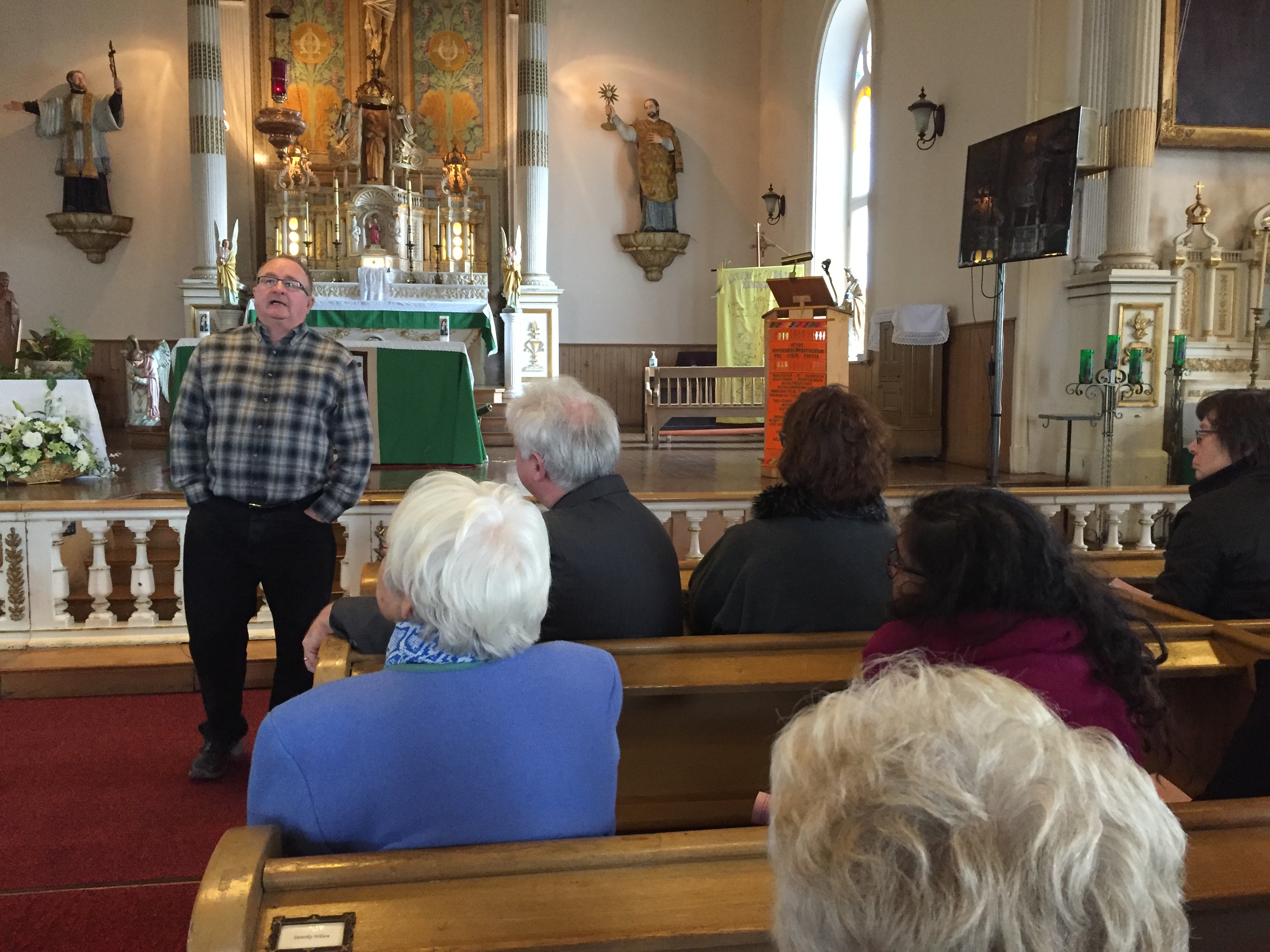
Yesterday, as some of you know, a group of us went to Kahnawake. We’ve been told by our last National Convention and also by our Bishops that we Lutherans should get to know our First Peoples neighbours. For us, that’s the Mohawks. So the Montreal Lutheran Council and Dean Jim Slack planned a morning of visits. Yesterday, off we went, across the Mercier Bridge.

Part of our visit was to go see the shrine of St-Kateri. Kateri was – IS, I should say – the first ever Indigenous woman sainted by Rome. A local saint. A lot of the Mohawk don’t go to church anymore and don’t necessarily care that much about it. But there was a member of the parish of St Francois Xavier church who gave us a very nice historical intro to Saint Kateri . Our guide proudly showed us the marble Kateri shrine containing the remains of the Saint. He showed us the painting of Kateri, who it is said, suffered from terrible smallpox scars on her face up to just moments before her death, when her skin miraculously cleared up and was made clean.

Our guide was a nice man, a very kind man, and a generous man. And clearly he was very interested in Saint Kateri. He was enthusiastic. He’d finished his historical intro and we were going to sing a hymn and say a prayer, when he said: “wait – if you’re interested, I have a special treat for you.”

What could he possibly mean? We wondered. He disappeared and came back with a small woven basket, with something in it. “Since you’re interested in Saint Kateri,” he said, “This may be for you.” There was something white in the basket. “If you’d like to have a special moment of veneration,” he went on, “we have one of the wrist bones of St Kateri. You can pray with the bone of the Saint right here.”

We all smiled. Several people nodded their thanks. Then our guide left. And we Lutherans just sat there, a bit stunned.

As a good Roman Catholic, it was perhaps the most gracious thing our guide could have done. It was incredibly generous. In one way, it was very thoughtful. But did our guide miss the memo? Did he not know that the group who were visiting the shrine yesterday was a group of Protestants? Not just that, but Lutherans? And visiting on, of all days, Reformation Day, the very day commemorating Luther, who railed against relics?

            Then I saw a new heaven and a new earth, says the book of Revelation, for the first heaven and the first earth had passed away, and the sea was no more. And I saw the holy city, the new Jerusalem, coming down out of heaven from God, prepared as a bride adorned for her husband. And I heard a loud voice from the throne saying, ‘see, the home of God is among mortals…and then the clincher: God himself will be with them.’

There’s something special when you can remember with ALL your senses. I don’t know about you, but when I smell certain smells – maybe a birch forest, or the smell of fresh bread, or the smell of grass right after a rain – memories just come flooding in. Touch is the same. I have a beautiful Bavarian sweater given to me by some friends in Germany. Every time I put it on and feel that rough wool, the memory of my visit with them comes back to me as if it were yesterday.

So I guess that’s what a saint’s bones might do for a person. That is, the right kind of person, in a tradition receptive to it. Which is not, to be honest, my tradition. I suppose that bones can be a symbol of what the prophet hears in Revelation, when he hears the comforting words God will be with the children of creation, not in idea only, but right there. Not having grown up with any kind of feeling for relics, I must admit that mostly, I found the sight of a wrist bone a bit off-putting. It was, for me, bizarre. I’d prefer to remember Kateri in my mind than to look at her actual enamel and marrow.

But does my discomfort mean there’s nothing to learn, or to be blessed by, in that situation? I don’t think so. Sometime we who are Protestants are too quick to dimiss the physical nature of memory, and the physicalness of the Creator’s love toward us.

On this mountain the Lord of Hosts will make for all peoples a feast, says Isaiah. And it won’t be a feast of ideas, but of real, solid things we know and treasure – the kinds of things we can taste and touch and smell: A feasts of rich food, of well-aged wines. It IS true that certain aspects of our faith are far, FAR more than intellectual. It’s true that some blessings need to be received that way: we taste the eucharist, we feel each other’s hands, or cheeks, when we pass the peace, perhaps we wipe tears from our eyes when we hear a hymn or a passage that touches us deeply. For me, and I think for others, one of the most powerful moments of the deconsecration service for Good Shepherd and for the Finnish church home was when we reached out and physically touched the walls with our fingers while thanking God for the shelter those walls had provided. Our Creator sometimes speaks most strongly to us through our senses.

There’s some talk that now-former Prime Minister Stephen Harper – who is, of course, very much alive – will be honoured by naming the Calgary airport after him. If that happens, it will be like Pierre Trudeau airport here in Montreal – a memorial that lasts long after the person is gone. Memory is inevitably connected to what is physical.

All Saints’ Day is a day for us to participate in this MORE-than-just-thinking, but-also-feeling kind of remembering. It’s a day for recognizing the ways in which, by means of much more than bones, those whom God has called saints have left us their witness. Physically. In bricks and mortar AND in bones AND in all kinds of other ways. This is what is sometimes called the “deposit of faith”, or Tradition. The witness of those who have died still lives on in ways that might surprise us. In our bank accounts in our churches, for one thing. In the hymnbooks in our hands. In our gestures. That witness might be in the very DNA we carry from faithful parents and grandparents, aunts and uncles, all the way back to the apostles themselves.

Death will be no more; mourning and crying and pain will be no more, for the first things have passed away. The scriptures want to tell us that this isn’t just the future and it’s not just the past. New life, in love, is what can be beginning, in hope and in the spirit, in our lives, right now. I am the Alpha and the Omega, says God in Revelations. The beginning and the end, the constant source of love and the memorial that can outlast each and every change, even the grave.

I watched what happened at the Kateri shrine after our guide went back to his office for a minute. Some of our little group of Lutherans wandered this way and that in the church. Some looked up at the frescoes. Some prayed quietly where they were for a minute. A few lit candles. Most went straight to the museum and the gift shop. Only a couple went to look at the bone. But nobody seemed all that bothered by it, one way or the other.

The most lasting memorial is love, however it is expressed. It can be expressed by a Roman Catholic guide who offers the best witness he has at his disposal, from his Tradition, to a group of strangers whom he wants to welcome. Love, says the Bible, endures. It is stronger than books AND bones, stronger even than the grave. Death will be no more, says the Lamb on the throne. But love goes on. Behold, I make all things new.

As we remember our loved ones with the sound of a bell and the smell and light of candles, and as we celebrate the faith that made those we remember saints, may these bones we inhabit really live. May the words of the prophet call forth the Spirit from the four winds, into our lives. And may the Almighty and the Ever-Gracious, the Lord of life, someday grant us, in our turn, the best, most real, and most lasting, memorial of life – a love that is remembered, physically remembered and lived out, even in, past and through, the grave that awaits but cannot contain us, God’s saints.

our guide

The Old Man behind Young Man Luther

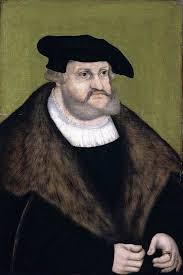
Frederick the Wise

Every year, on Reformation Sunday, I feel a bit silly. You know how every now and then you hear that it’s “pet appreciation day” or “national wildflower day” or something like that? Well, Reformation Sunday feels a bit like that for me. It FEELS made-up. Reformation Sunday is a celebration no one but Lutherans knows about. Frankly, nobody seems to care that much about it, either.

If you were to walk over to the grocery store after church and ask people who Luther was, you’d get blank looks. Maybe a few folks would know something about Martin Luther King Jr. But no one remembers the 16th century monk after whom our church is named. Except us. And even us, not so much.

Just in case you think I’m being cynical, I’m not. Clearly, there IS a place, if not for Luther, at least for Reformation. This week we Canadians voted out one majority government and voted in another. We voted out one prime minister and voted in another. Overwhelmingly. A lot of people must have thought there was a need for reforming things. And that’s just the way life goes.

In his world, Martin Luther was a great beacon of change, a fighter for the common person. But today I’m interested in someone else, someone who was there with Luther, but very much behind the scenes. If Luther is not that well known, this person is even less. He was Elector Frederick the Wise, of Saxony.

I think we should aim to be someone like Frederick. Maybe not with quite so big a stomach….

Frederick was the Duke who sort-of, from behind the scenes, helped Luther. The reason I’m interested in Frederick is that he was old. Like most of us. He was also quite happy with the way things were. He didn’t need change. Probably was suspicious of it, a bit. He was basically comfortable. Again, like most of us. And, at least until Luther came along, he was likely pretty invested in keeping things the way they were.

It all sounds quite familiar. Frederick was NOT a young revolutionary. But somehow, despite all that, when the moment of decision came, when God’s moment to shake up the Church came, Frederick had the courage to be the old man behind the young man Luther. He knew what he knew. He could see with his own eyes that things needed changing. And he risked his own comfort to help make that happen.

I think that’s our battle. Not to be Luther. We’re too old, and probably most of us too comfortable. But to be – at least – Frederick. That takes courage too.

The days are surely coming, says the LORD, when I will make a new covenenant with the house of Israel and the house of Judah. It will NOT be like the covenant I made with their ancestors…

Yesterday Bishop Pryse came to Montreal for his regularly scheduled visit. He told us what we already know: you’d have to be blind not to see that the church is changing. Our pews are emptying out. Young people are not coming in. The old days of big church picnics and full programming and not enough space for all the people are gone. The average age in our congregations is, at least, in the 70s. The days of a full-time professional, paid pastor for every church are gone. What does that tell us? The old ways of doing things aren’t working.

But are you and I going to be Luther? Really? Do we have the energy and the vision to nail our thoughts to the public doors, to debate against the powers of our world, and to take them all on?

I’m not sure that’s our battle. I’m not sure it’s who we are. So perhaps, being older Lutherans, from older, established congregations, congregations that are facing the end of things as we know it, congregations that often have more money than vision, we need to look out at our world and say: okay, maybe I’m not the one to actually bring the changes. But. Maybe I’m being called to support, to pray for, to guide, to help pay for, to protect and cheer for. Or – at the very least – not to stand in the way.

I will make a new covenenant, it says. Emphasis on the word NEW. It will NOT be like the covenant I made with their ancestors…

The Bishop told us that the very model of what it means to be a church has to change. The structure of our Synod and committees goes back to the 1950s and 60s. It was based on the corporate model, on companies like GM. Well, look at what happened to GM! We’re behind the world, not ahead of it.

The needs are just as great as they always were. Luther fought against oppression and ignorance and slavery. Those things are still, very VERY much, with us. We still have the hucksters. Like in medieval times, our leaders still try to use fear to control us.We’re STILL offered fake salvation, this time in bank accounts, in what we call ‘securities’. Our Creator still needs courageous disciples to speak out for freedom, and dignity, and respect for a gracious and free gift of life in our days.

The struggle is happening. So what role will we play?

Frederick had to swallow a lot from Luther. For one thing, Luther taught and preached against relics. Ironically, it was Frederick, Luther’s protector, who had the biggest relic collection in all of central Europe. Luther’s JOB – his professorship – was paid for by the very person and relics he was attacking. Do you know what kind of courage it takes to take a public stand against your own paycheque? But then imagine the courage it takes to let an employee speak against you, just because he or she may be right.

Reforming an institution isn’t easy. When we tore down the old church at Good Shepherd, it was not easy to see the walls and ceiling we had worked hard on, come down – I remember sitting on that roof myself. But the walls HAD to come down, in order for a new way of being church to be born. Just like Frederick’s relics had to become useless so that the good news of God’s love could be told in a new way.

You will know the truth and the truth will set you free, Jesus told his followers. We still need to hear that, and to share it. And since we now live in a world and a time where people are not flooding in through our doors, we need to find ways to go OUT through those doors. To be the church out THERE, in the world. Like for Frederick, it will mean supporting others, if we don’t have the ideas ourselves. It will mean seeing a Luther, and giving up something to make their gift of change happen.

            I know how sad I was to leave my last house. I’d spent so much time and money to make it just the perfect kind of space. I’d designed it to be perfect. But the time came to move. And I remember how STRANGE my new apartment seemed when I first moved in, and how odd the neighborhood felt.

But now, I can hardly imagine being anywhere different. I’ve discovered joys I didn’t know before, of being able to walk to work, of cleaning a smaller space, of a neighborhood with so many good restaurants. Things I would never have known without moving.

One thing is certain in our churches: we need to change. As the Bishop has said, it won’t always be easy. Probably, like Luther, we’ll make some spectacular mistakes. But if we don’t try, we won’t be faithful to this day, Reformation Sunday.

It still feels a bit, to me, like a made-up day. Our version of “adopt-a-caterpillar” day. But if Reformation Sunday seems a bit odd, perhaps we could call it Be-Like-Frederick day. And we could remember that, even old, and settled, and stuck in our routines, and happy with our lot in life, God might still be calling us comfortable Christians to support the winds of change blowing through our church. That way, we too might play a part in bringing the good news of love and life in a new way, to a new world.

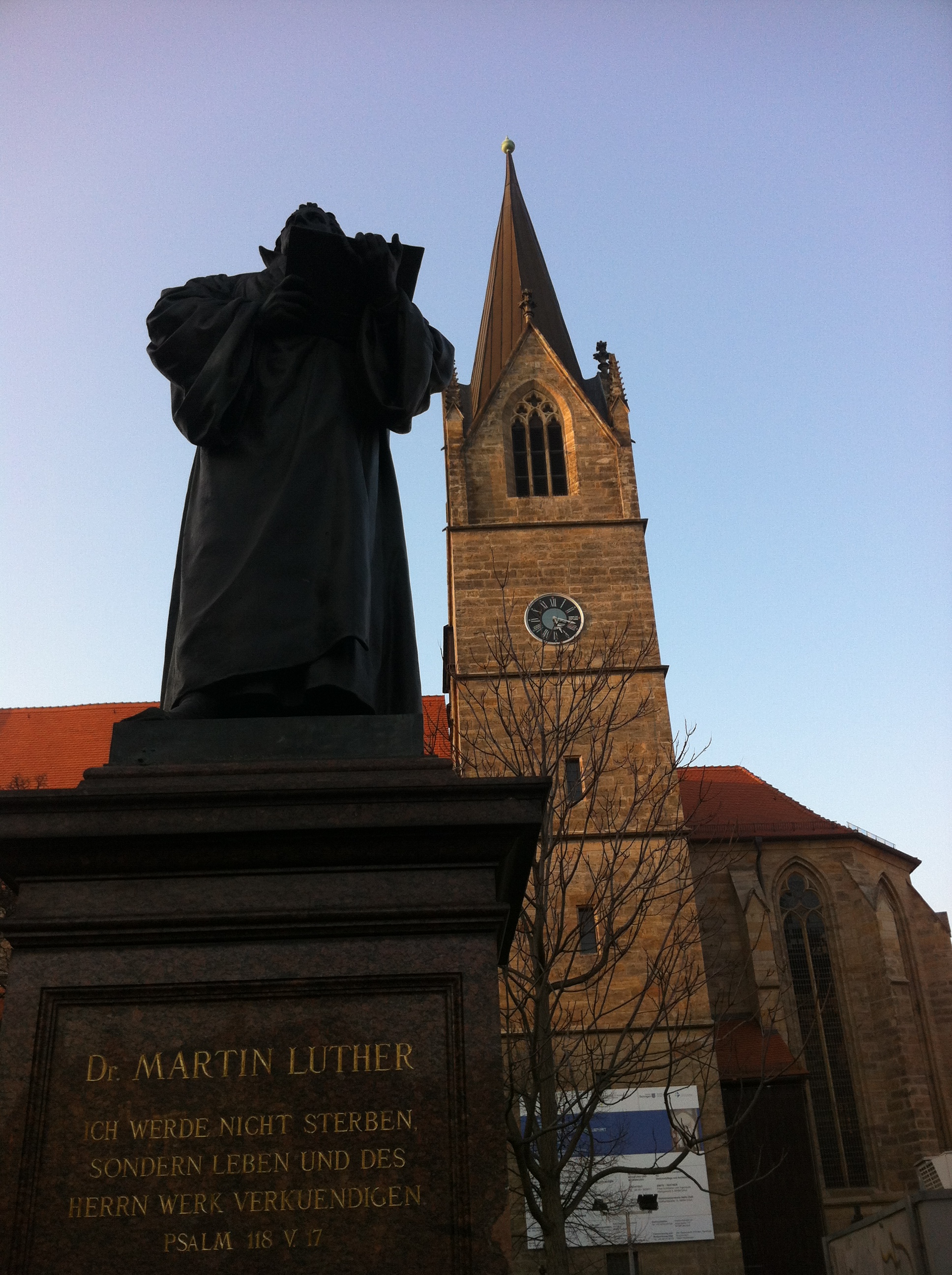
Erfurt Luther statue

English is so Difficult

ski trail Psalm 23 Finnish

Several times now while walking downtown I’ve walked by a children’s park on the river with colourful images of the game “Angry Birds”. Wow. These Finns are really commercialized, I thought. Until Sari told me: did you know that Angry Birds was invented here in Rovaniemi? The creators donated money and play equipment.

I walk past the lonely little fast-food “grilli” where, my first afternoon, I bought a sausage and stood in the snow in the middle of the empty parking lot to eat it. Then up the pedestrian walk, past the display of reindeer antler jewelry, imitation Sami shoes with their upturned toes, and ice sculptures. I wander into one of the local “Safari in the Arctic” waiting areas. There are two friendly young women at the reception who tell me they don’t mind if I use the wi-fi. As I work, a United Nations of tour groups pass through. They are back from snowmobile and snowshoe journeys, and are returning their helmets, gloves, and full-body suits. There is a long wall of packed snow blocks that the city has required the companies to erect to muffle the sound of so many snowmobiles taking off. I hear Chinese, Hebrew, French, Russian and English, and some languages I can’t identify.

My few phrases of Finnish are already growing stale: “Mina olen pappi ja professori montrealista” “kiitoksia” “hyva paiva”. But I’m at least starting to be able to identify a few words better when Finns say or sing them: “makara” (sausage),   “kirkko” (church), “kotti” (home), “karhu” (bear), “lapsi” (child), “laulua” (song) and “rakasta” (love). I guess the words I’m learning reflect my visit. Or maybe Finnish culture, at least here .

The fluidity with which Finns switch genders in their speech is often funny, and sometimes disconcerting. Because there aren’t different words for “he” and “she” in Finnish, when speaking English to me, the Finns here may just choose one at random: “Oh yes, my husband is a tall man and she is strong too.”

I’ve also learned that there are many different words for “bear”. The reason, apparently, is that in the “old religion” you were never supposed to say that word. They came up with synonyms and other ways of describing the powerful creature, which not so many years ago had the status of a god. I think about the Bible, and the way that Yahweh’s name was never to be spoken aloud.

My host for the last day in Rovaniemi is Ilari K. He is a pastor in the church that is hosting my second set of documentary showings. Although he looks to be barely out of his twenties, he tells me that many years ago he and his wife and first two children (they now have five) spent a year in Saskatoon. Immediately we start comparing memories. He takes me to the university where I meet the chaplain, Heini, and tour the building. We three have lunch together. After, when I ask him to drop me at a wi-fi spot, Ilari simply takes me to the family home.

I walk in to meet a very young-looking woman whom I assume to be Ilari’s wife Kaija. I give her the flowers I bought at the supermarket while Ilari picked up groceries. “This is my daughter,” Ilari says as I hold out the flowers. Then, just when, stammering, I start pulling them back, he corrects himself: “I mean wife.”

English is so difficult. Either that, or it’s that Finnish sense of humour again.

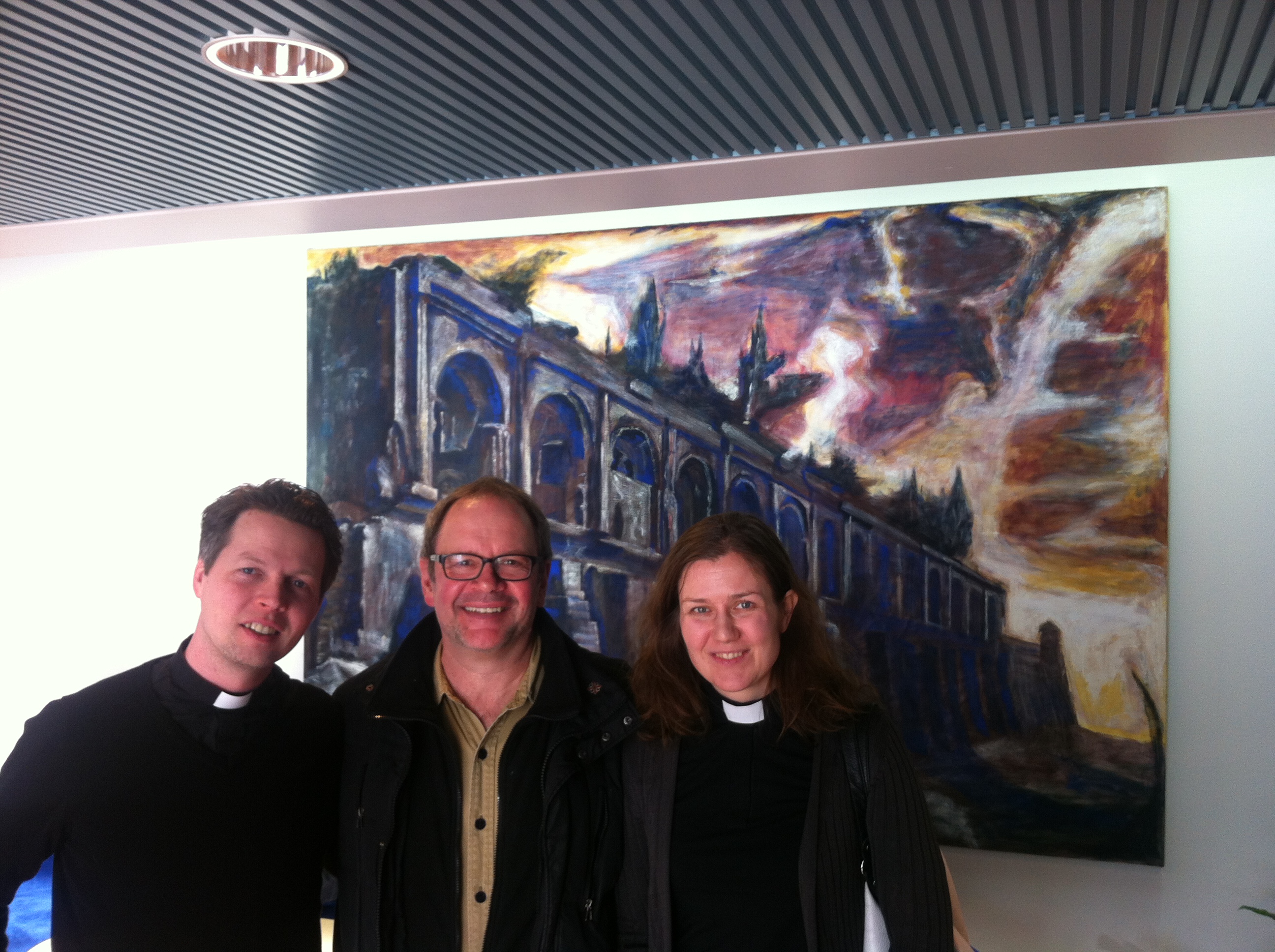
Heini Ilari and Matthew

Ilari Kaija and family

If You Put Mont-Tremblant at the Top of Europe

Levi ski area

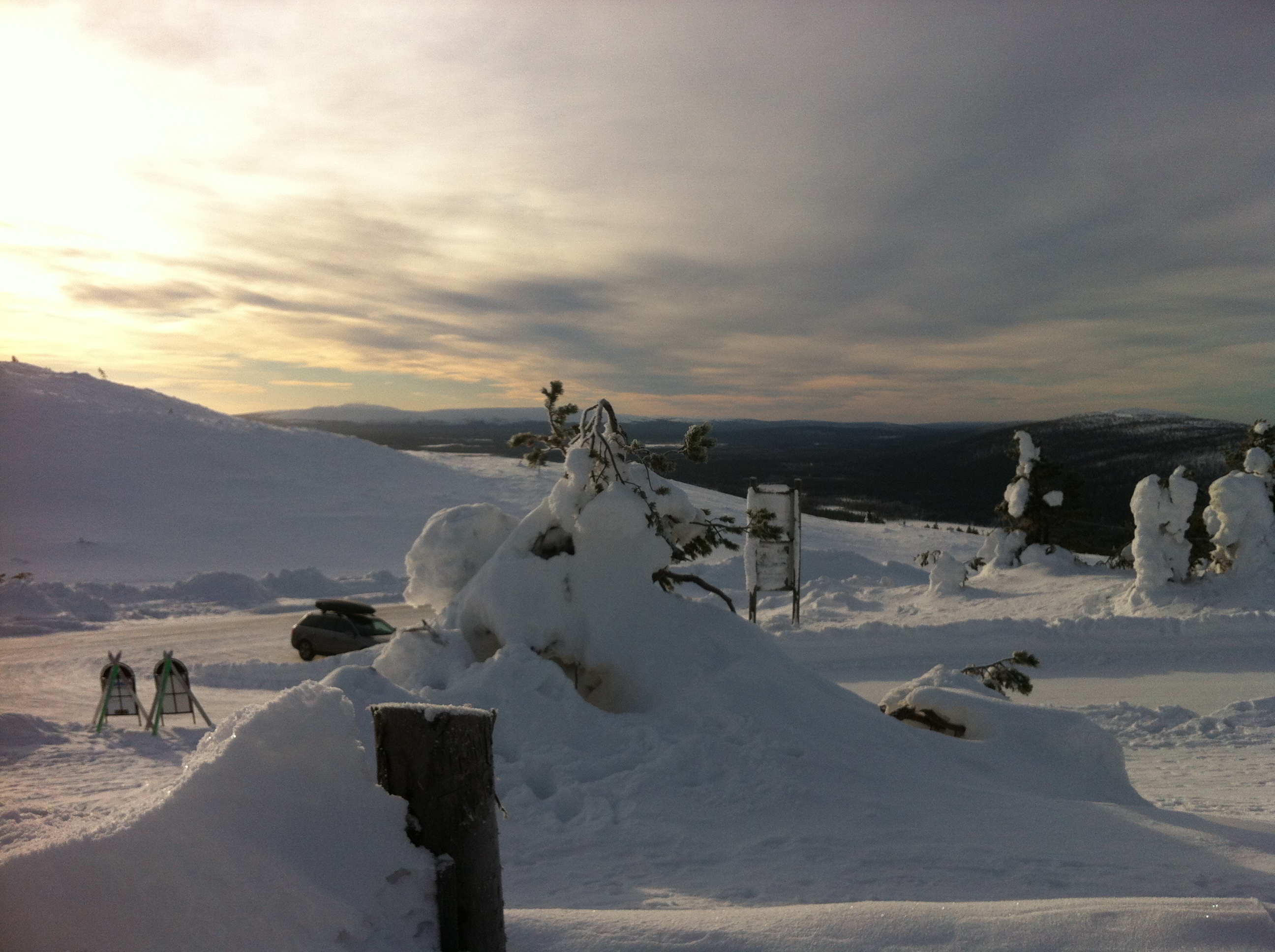
Okay, there are a few differences. At the bottom of the hill at Levi, Lapland (about 120 km north of the Arctic Circle), behind the state-of-the-art chairlift (heated seats, a tinted canopy and a conveyor belt to help you get on), there’s a wooden tee-pee where people crouch in the semi-darkness over a fire and cook their sausages for lunch. There’s one electric-car recharging station in the town, and the rental shop carries the standard glittering equipment you’d get at Lake Louise or Chamonix. But there are also posters advertising reindeer rides and Lapland igloos where you lie on your back and watch the northern lights. (They neglect to mention that there’s been little sunspot activity this year and a corresponding drop in occurrences.) The snack bar has all the usual fries and hot-dogs, but also salmon on rye rusks, reindeer burgers and a kind of potato pancake that they call ‘bread’ here but reminds me of a thicker Norwegian lefse (apologies for using one obscure Scandinavian cultural reference to help try to explain another!) In fact, we’re only a couple of hundred km from that northern reach where Norway and Finland greet each other overtop of Sweden, and sometimes ski accident victims here might be taken to a Norwegian hospital rather than a Finnish.

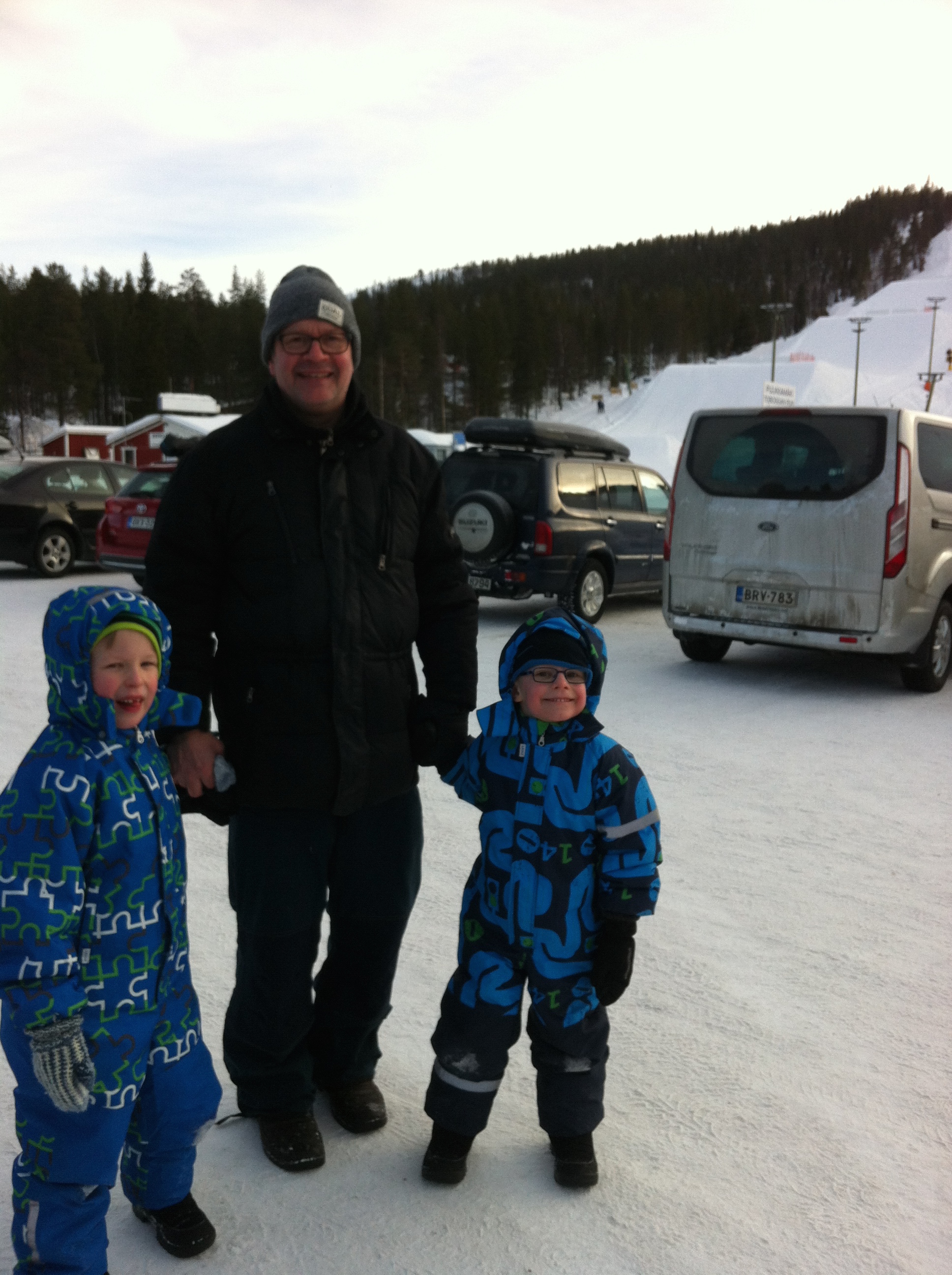
I help Kaapo and Oiva, my host family’s boys, get into their snowsuits. Kaapo is not feeling well. Their father, Matti, has been shovelling snow off of the family’s cottage roof all day, but the big man seems none the worse for wear despite the back-breaking labour. Sari and Matti take me to the restaurant near where they met, and treat me to a local speciality: a warm, flat Lappish cheese with accompanying cloudberry sorbet, and a thick caramel sauce on the side. I may not be in heaven, but I’m close. On the way out, I pick up the local Levi Times paper: “Kittila became an independent parish by Russian imperial edict on 30 January 1854,” it says. “Population 6500. There are 900 inhabitants in the town of Levi and rooms for 24,000 tourists. Unemployment rate 13%, 718 lakes and reindeer approximately 12,000.”

with Oiva and Kaapo Sari and Matti

The Accidental Ambassador

poster at Wiljami theatre Rovaniemi      movie is starting

Even though the Suomi Conference of Canada sent me to Finland to experience Finnish culture, I’m realizing now that I’m here, that I’m representing Canadian Finns to the homeland. Which is ironic. Who needs an ambassador who can’t even speak the language?

But the pleasure – and the privilege – is that I’m meeting relatives of Finns in Canada, who come to see my documentaries just because I’m a living connection to their family. “We are cousins to Heiki and drove 100 km to see you,” says one man, in carefully-practiced English. I hope that he will get something from the (not-Finnish-language) films. There are Finns who spent a winter, or two years, or a few weeks, in Vancouver or Toronto, who have come because I represent that land they left behind. Or Finns who might be coming to Canada for a term or a job, because they want a sense of the place.

First there are local singers who perform. Then my documentaries. After seeing the movie, the people shake their heads: “it’s not easy being an emigrant,” they say, “being caught between here and there.” Then, through translation, some of them talk about being caught between Helsinki and Lapland, or about their grown children traveling to the United States or to South America – and how they’re afraid that they will meet someone and settle down there, away from parents and home. A few in the audience know someone in the film. One woman cries, quietly.

When they hear that the Suomi choir in the film is coming back to Finland, I hear murmurs: “they’re coming here to the north I hope!” I answer “We’d love to!”, even though I then have to add that I know nothing about the choir’s schedule and have zero power to change it.

Then, the lights lift, and people move to their coats and after a few more “kiitos’s” they are gone. I collect my things. Sari – who has been such a wonderful host throughout – will drop me back to my apartment. She knows I haven’t eaten since breakfast. “Are you hungry?” she asks. I still haven’t figured out the eating patterns here, which seem to include lots of food in the late evening after sauna, and sausages outside following every snow activity. But neither of those is the situation today. I think perhaps this will be the occasion for more Lappish cuisine. “Sure,” I answer. “Great,” she says, leading the way out the door: “I was thinking Chinese”.

singers at presentation

Reindeer and Skiing on Sidewalks

Matti was here graffiti

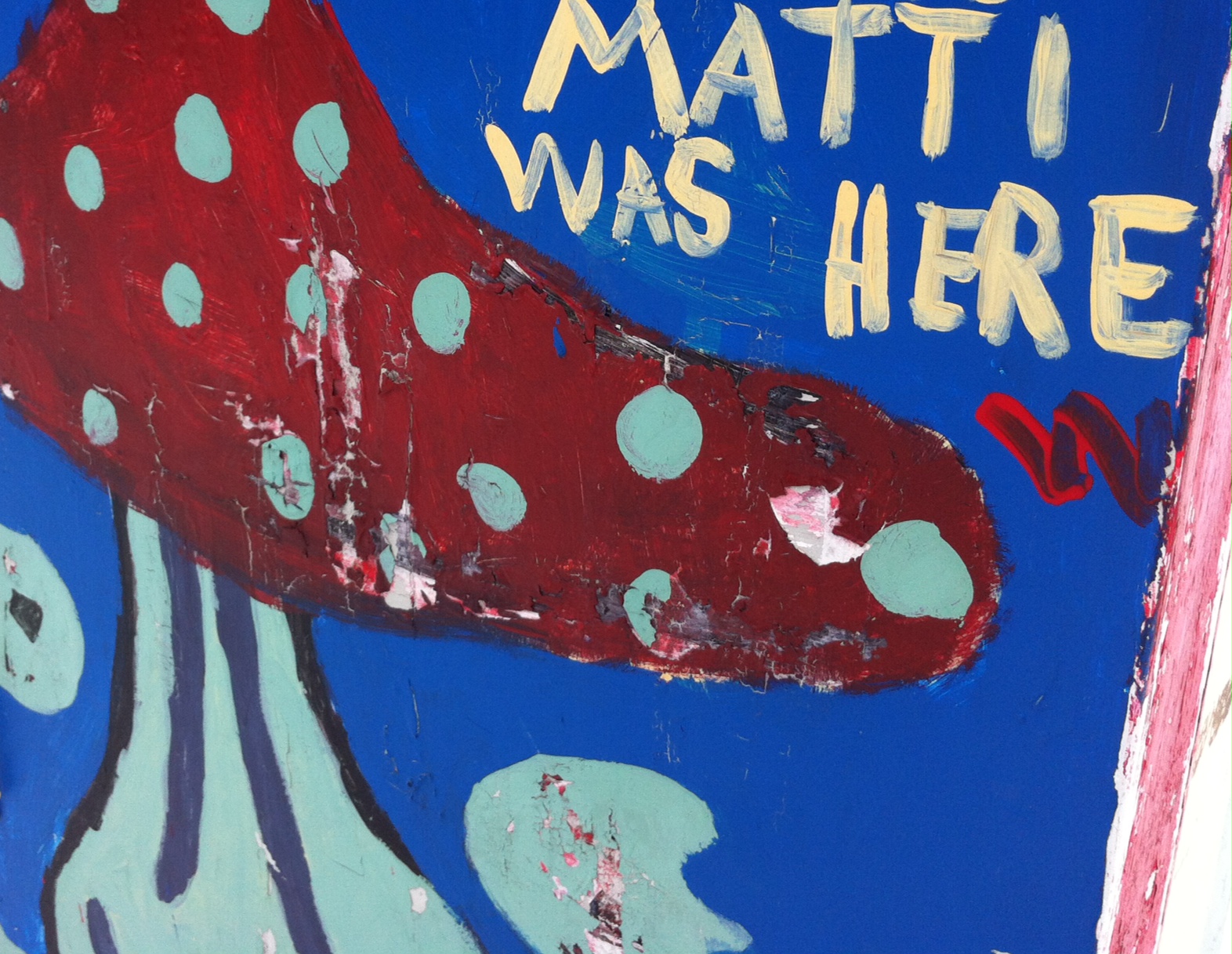
It was when she started talking about how properly to hang and cure reindeer meat that I knew for sure I was in Lapland. It was also right around then that we realized there were no taxis to take me back to my church apartment.

The day had begun when I set out walking to Arktikum, the official museum of Lapland and of Rovaniemi. It’s a long, elegantly beautiful building on the edge of the Ounasjoki (Ounas river), about two kilometres from where I’m staying. Inside the museum were displays of Sami sleds, Sami traditional dress and the all-important drums. In fact of all of Sami history is represented, including beautiful 7th century jewelry that reminded me of similar Anglo-Saxon and Irish finds.

I walked back through town, just in time to meet the vicar of the parish, Kari Y, who promised to end my internet troubles by handing me a 3-G stick. I asked him about the church that he heads. Some parish: there are 22 or 23 pastors on staff and about 120 employees! I keep bumping into clergy types who tell me they’re pastors in the parish. Apparently, they all are.

Just as I left the office building a smiling woman in a white parka walked into the parking lot. You must be Matthew, Riita K-K said. Do you like ice cream? Sure! Then come taste our newest local product…. From the Arctic Ice Cream Factory. I tried the “spruce tree” flavour – it was delicious. Riita interviewed me for her own paper, the Lappilainen, a weekly, and also showed me an article about my documentaries in another paper, the UusiRovaniemi. I’m glad to know the word is getting out. On my way back from the interview a woman passed me on the sidewalk, on skiis. Most Rovaniemi people, however, if not driving, seem to prefer walking or bicycles, even on the ice and snow.

It was soon time to meet Sari again, this time for a concert and my first look inside Rovaniemi kirkko, or church. The fresco behind the altar is magnificent. By Antti Salmenlinna, it dates from the early 1950s, when the church was built. I asked Sari about all the new architecture. Oh, there are almost no old buildings in Rovaniemi, she said. The Germans burnt the city down when they left in 1944. It’s a bit awkward to say that to German tourists these days, but – she looked at me with that typically inscrutable Finnish expression – it’s all right. As we explored I noticed paintings along the side arches, one of them of a man with a reindeer, to illustrate Jesus’ sayings in Matthew.

The organ concert was wonderful, with two international artists spelling each other off like spoken-word performers, getting more and more physical with the classics of popular organ music. Of course there was also Sibelius’ Finlandia. Sari, who is supposed to be on holidays, doesn’t act much like it, speaking with parishioners and handling details constantly, and I worry that part of that is due to my visit. She gave me an updated agenda for my visit. More meetings!

Then she drove me back to Riita’s place for my second sauna of the trip. I hope you don’t mind, Riita said with unnecessary apology, that here in town we have only the electric type. She fed me bread and cheese and sent me in, after which she and her son took turns. Then we talked for a bit after, over fruit, about global Russian muscle-flexing. Sweden and Finland just signed a pact to share armed forces, she informed me. The Russians have just reactivated a military base that had been abandoned, on the other side of the border. She talked about the old days, about communist youth, and about trips to Murmansk, and Leningrad, and Moscow. Then she told me about her work in helping build community right in Rovaniemi, and the “pop-up restaurant” concept, where Finns get a chance to open a restaurant in their own home or with a neighbour, two or three times a year.

Soon it was late, and I was ready to go. No taxis were to be found. Oh, you’ll be all right, said my host. Just look for the spire of the Kirkko, it’s the tallest building you’ll see. And follow the cross all the way home.

So I did.

through the photographer lens

Rovaniemi church fresco

fresco of reindeer herder

A Warm – too hot! – a welcome to Rovaniemi


Sauna One

My Ash Wednesday in Finland began with a flight north. I left behind the beautiful old 19th and early 20th century buildings, the gritty sidewalks and the cold sea wind of Helsinki and landed in the sunny, white and still world that marks the beginning of Finnish Lapland. It was so strange to be surrounded by banks of snow, yet feel warmer than I had in Helsinki. “It’s a dry cold,” someone said. Rovaniemi feels like Saskatoon or Edmonton on a nice winter day. Even looks a bit like it.

Right now the Arctic Circle, ironically, is warmer than Montreal. Pastor Sari Kuirinlahti met me at the airport. “I have hugs for you,” I said, “from Riita and Olavi Hepomaki and from Jari and Liisa Lahtinen. Is that okay?” “Oh!” she answered, “I miss those people!” And she let me give her the hugs, even though she blushed. Then she handed me a chart with all the things I’m doing in the next few days, based on what I had emailed her. Two documentary showings in a theatre and a chapel, a couple of interviews, a trip, meetings, some concerts…..

But first, she said, sauna! Have you had sauna yet? I admitted I had been two days in Finland already without sauna. You will be picked up this evening, she informed me. Get ready (I wasn’t sure exactly what that meant). The afternoon gave me time to settle in to the “Piispankameri” or the so-called Bishop’s room, which when a Bishop isn’t visiting is used for other guests like visiting musicians, or in this case, me. Cross-country skiers were passing by in front of my window. Having no skis, I walked to a local store and bought some food for the apartment, with the very kind clerk taking me around by the arm and helping me find what I needed, then warmed up some Karjalan Pirakkat with tea. Sari returned and took me to meet church volunteers. They asked, with Sari interpreting, what I thought the challenges facing my congregation (and the church overall) in Canada are. It turns out there are many similarities, despite the differences. Then another pastor (they seem to be everywhere here), Tuomo K, whisked me away to the church camp at Norvajärvi.

There were men there in the woods by the frozen lake. Many men, of different ages, in the saunas, towelling off, out standing in the snow, or cooking Finnish sausages over a fireplace in a hall. I sat in the sauna listening to the quiet hiss of steam. My host made it hotter and hotter until unable to bear the steam any more we had to run, naked, out to the snow. “A warm – sorry, a hot! – welcome to Rovaniemi” he laughed. We had arrived late so most of the men were already dressed and setting up for their discussion. I waited until the others were gone and then did what I had promised myself I would do. I fell back into the snow and looked, oh so briefly, at the stars, ten kilometres north of the Arctic Circle.

The men sang a hymn, said a prayer, and I introduced myself to them in my very few words of Finnish. Then they fell into their planned discussion: how to be a Christian and involved in political life. It was all in Suomi, so I could only pick up a few words – socialism, communism, capitalism, faith, God. In this area the communist party was very strong for many years, and tensions sometimes ran high. Still, after the heat and steam and flight, it was hard not to nod off. The man beside me did, but then revived every now and then to add a few words to the discussion.

Then it was back down the highway, past the “watch for elk” and “Arctic Circle” signs, and boots crunching in the hard-packed snow, back to my room. “Kiitoksia!” I called out. “Good sleep!” my host answered. After that sauna, it won’t be hard to have a good sleep. Welcome to Rovaniemi.

You’re What? An english-speaking Finnish pastor from Canada? How does that work?

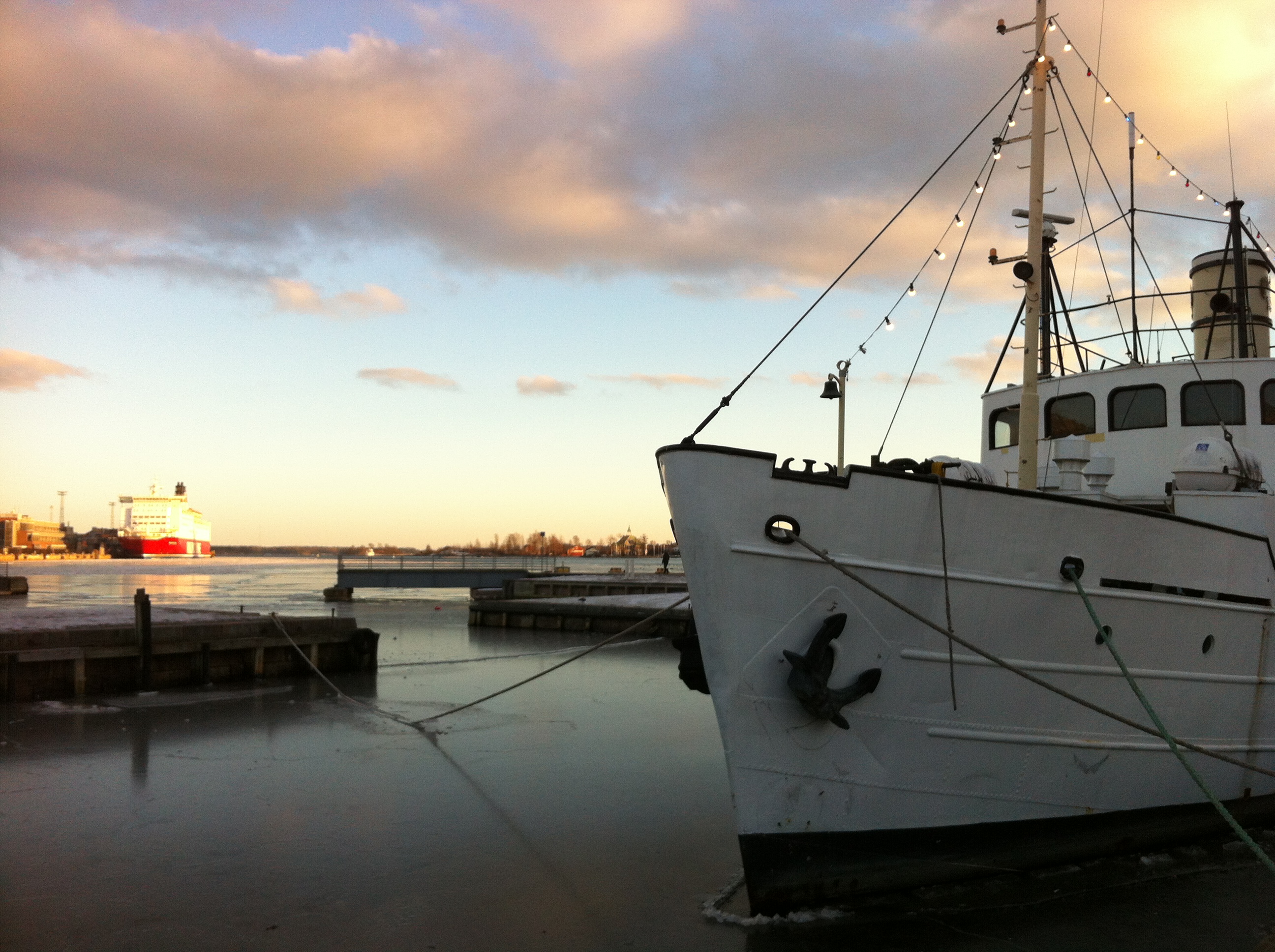
Helsinki harbour in ice

When I walked by the Fazer chocolate shop and teahouse, there were two young women standing outside, shivering in heavy coats and aprons. “Do you have hot chocolate?” I asked them in English. They nodded enthusiastically: yes! And for free! So I had some hot chocolate and drank it while looking for the Kappeli, where I was meeting my afternoon appointment, a professor from the Greek Institute.

What a great welcome to Helsinki. And in February, too.

My first full day in Finland was a busy one. At breakfast I met Teemu, who came with two of his children. He was to be my “barefoot” (as the Helsinki locals call themselves) guide. But a last minute situation meant we could only visit over breakfast. “I love Thunder Bay,” he confided. “I go there often. Canada is a good country. Almost great.” He smiled, that same quiet, ironic smile I’ve seen on so many Finns. Waiting for me to get the joke.

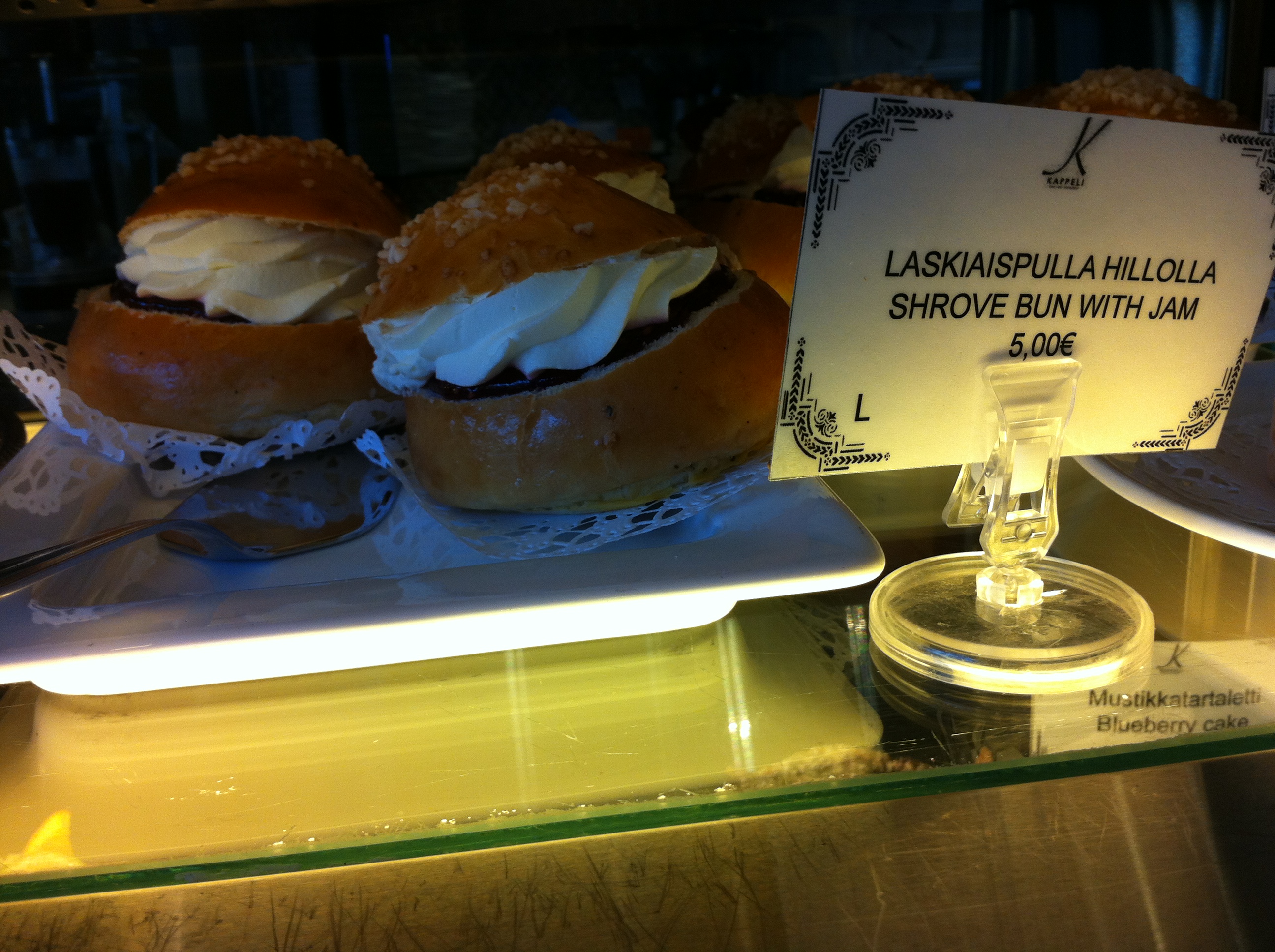
I bought a one-day transit pass and hopped the #9 streetcar to the Kallio area. I was treated to lunch and my first Laskiaispulla, or Shrove Tuesday bun, by Heidi R., a pastor, journalist and passionate interfaith worker. The pulla was amazing – but really, really hard to eat! And hard to eat during a radio interview. We spoke about Finns in Canada and the USA, my two documentaries, and the Camino de Santiago. The interview, once edited, is supposed to be aired on Finnish national public radio at some point in the next few months.

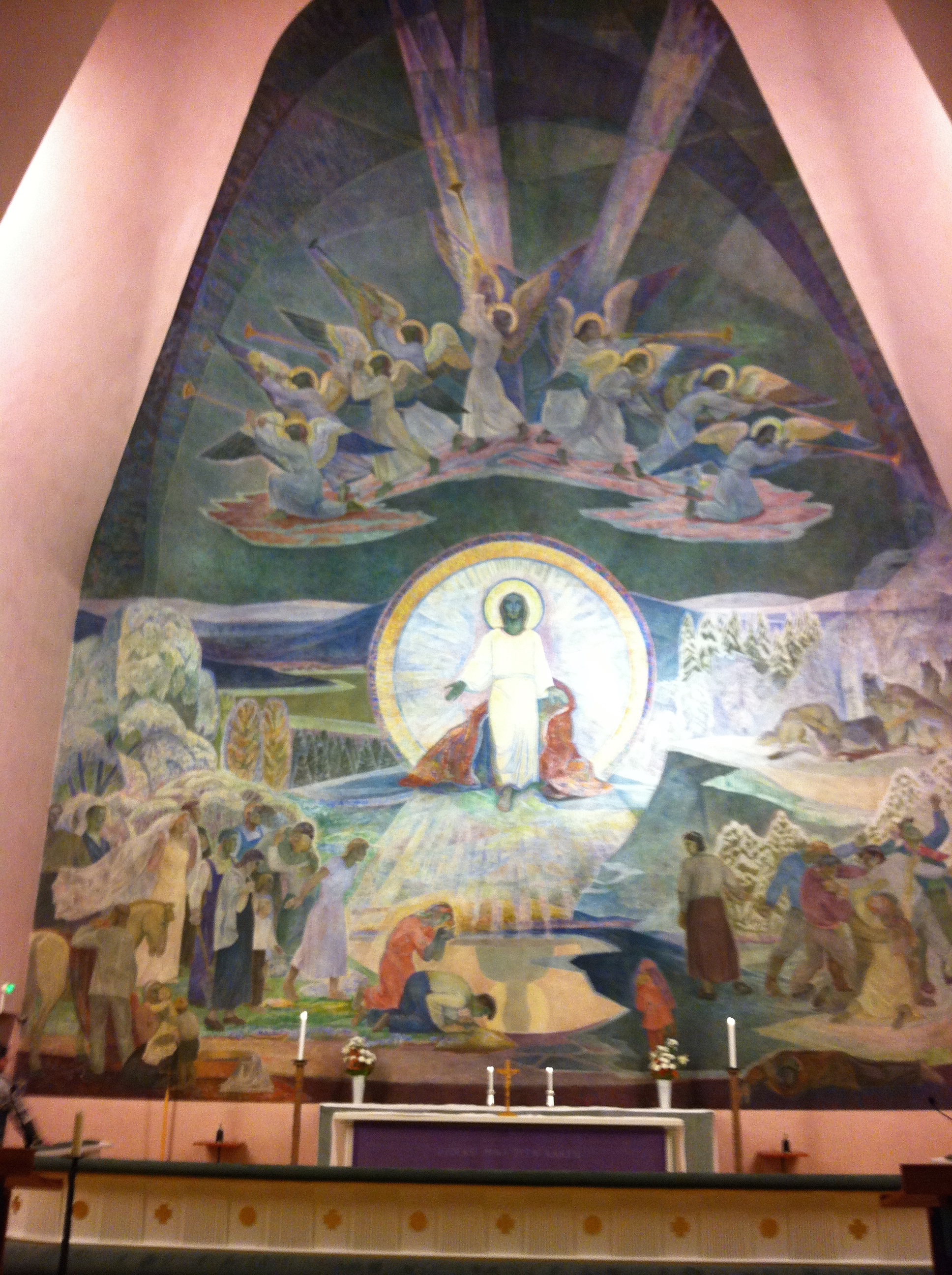
After, Heidi took me on a quick tour of a building I’d passed and wanted to see, the Kallio Church. The style, inside and out, is “Finnish Art Nouveau”, says the pamphlet. It looks a lot like Art Deco to me. It’s beautiful, and I loved the altarpiece of Jesus with the local working people of the neighbourhood.

Then it was back downtown by metro to meet Mari R-S, an academic whose work I had seen in the library and whom I had contacted. She brought her new four-month baby, and I managed to steal some time to hold him while we talked about tourism and pilgrimage. We also talked about rashes, and allergies and how much babies sleep (or don’t)! There was more Laskiaispulla, which of course had to be eaten.

After Mari left I walked up to the Cathedral. There was a pastor sitting in the corner, to whom I introduced myself. She seemed a bit confused, but friendly. “You’re what? An english-speaking Finnish pastor from Canada? How does that work?” I told her I wasn’t quite sure how it works, but that it does. She smiled and shook my hand. I’m not sure she believed me, just showing up like that, unannounced. Finns would never do that.

On the way back to my hotel I did some tourist shopping, and then had just enough time to change before meeting Kati B, a former church council member from the Finnish church in Montreal, and Mari T, a journalist who worked at Isien Usko and Kanadan Sanomat, for dinner. Both have now returned to Finland. Over salmon burgers and fish we talked about Canada and Finland, about how long one can be away before they ‘stop being Finnish’ and how long it takes to be Finnish again after coming home. “Maybe our generation is more used to this in-between feeling of never completely belonging in any one place,” said Mari. I believe that in our globalized world, that might be true of many people.

After dessert I walked the two of them to their tram. Tomorrow I fly to Rovaniemi. I’m thankful that the Suomi Conference has sent me here “to experience Finnish culture”. There seemed to be quite a bit happening, even in what was just my first day!

laskiaispulla Shrove Bun

Heidi Rautionmaa Kallio church

Jesus and working class clearest